
Aluminum foil has become one of the most important materials in modern packaging. From disposable food containers and household kitchen foil to pharmaceutical blister packs and industrial insulation, aluminum foil is valued for its excellent barrier properties, lightweight design, recyclability, and food safety.
However, the performance of any finished aluminum foil product begins long before it reaches the production line. Choosing the right aluminum foil raw material directly affects product quality, production efficiency, forming performance, waste rates, and manufacturing costs. Whether you operate an aluminum foil container factory, convert jumbo rolls into household foil, or source raw materials for packaging production, understanding the characteristics of aluminum foil is essential for making informed purchasing decisions.
This comprehensive guide explains everything you need to know about aluminum foil raw materials, including:
- What aluminum foil raw material is and how it is produced?
- The complete manufacturing process from bauxite to jumbo rolls.
- Common aluminum foil alloys and their applications.
- How to evaluate material quality before purchasing?
- Factors that influence aluminum foil prices.
- Best practices for storage and transportation.
- How to source reliable aluminum foil suppliers from China?
Throughout this guide, you’ll also find links to more detailed articles covering each topic in depth, helping you build a complete understanding of the aluminum foil supply chain.
What Is Aluminum Foil Raw Material?
Aluminum foil raw material refers to large aluminum foil jumbo rolls produced by rolling aluminum alloy into extremely thin sheets. These jumbo rolls serve as the starting material for a wide range of downstream converting and packaging processes. Manufacturers purchase these rolls and process them into finished products through cutting, embossing, printing, laminating, rewinding, or stamping.
Unlike finished consumer products, aluminum foil jumbo rolls are semi-finished materials designed for industrial production. Their specifications—including alloy, temper, thickness, width, and surface quality—are customized according to the intended application.
For manufacturers, selecting the appropriate raw material is just as important as choosing the right production equipment. A mismatch between material properties and production requirements can lead to forming defects, higher scrap rates, inconsistent product quality, and increased operating costs.
Key Specifications of Aluminum Foil Raw Materials
When purchasing aluminum foil jumbo rolls, buyers typically evaluate several technical parameters:
- Alloy: Determines strength, formability, corrosion resistance, and end-use suitability.
- Temper: Indicates the material’s hardness and ductility, such as O (soft), H22, or H24 etc..
- Thickness: Usually ranges from 0.006 mm to 0.2 mm, depending on the application.
- Width: Customized to match converting or stamping equipment.
- Inner Core Diameter: Commonly 76 mm, 152 mm, or other customer-specific sizes.
- Outer Roll Diameter: Influences production efficiency and transportation costs.
- Surface Finish: Clean, smooth, and free from oil stains, scratches, wrinkles, or oxidation.
Each of these specifications plays a critical role in production performance. For example, container manufacturers often prioritize excellent elongation and deep-drawing performance, while household foil converters may focus more on consistent thickness and rewinding efficiency.
Related Reading:
How Aluminum Foil Raw Material Is Manufactured?
Before aluminum foil reaches a packaging factory, it undergoes a highly engineered manufacturing process involving mining, refining, casting, rolling, annealing, and quality inspection. Each stage influences the final material’s strength, thickness consistency, surface quality, and forming performance.
Understanding this production process helps buyers better evaluate supplier capabilities and identify factors that affect product quality.
The Aluminum Foil Manufacturing Process
The production of aluminum foil typically follows these steps:
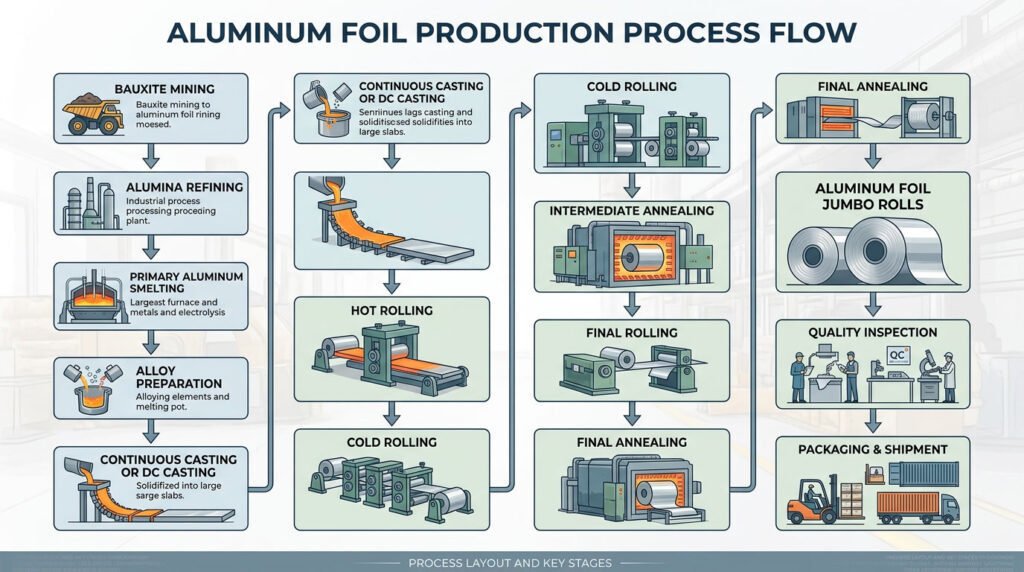
Each stage is carefully monitored to ensure the finished jumbo rolls meet strict specifications for thickness tolerance, mechanical strength, surface cleanliness, and dimensional accuracy.
Step 1: Bauxite Mining
Everything begins with bauxite, the world’s primary source of aluminum. Bauxite ore is extracted from open-pit mines and transported to refineries, where impurities such as iron oxide and silica are removed.
The quality of the raw ore influences the purity of the aluminum produced later in the manufacturing process.
Step 2: Alumina Refining
Using the Bayer Process, bauxite is refined into high-purity alumina (Al₂O₃).
During this stage, unwanted minerals are separated, leaving a white powder that serves as the feedstock for aluminum production.
Step 3: Primary Aluminum Smelting
Alumina is converted into molten aluminum through electrolytic reduction in large smelting facilities.
Manufacturers may also incorporate recycled aluminum depending on customer requirements, alloy specifications, and sustainability goals. Modern aluminum production increasingly combines primary and recycled materials to reduce environmental impact while maintaining product performance.
Step 4: Alloy Preparation
Pure aluminum is rarely used directly for packaging applications. Instead, alloying elements such as manganese, iron, and silicon are added to achieve specific mechanical properties.
Different alloy compositions determine characteristics such as:
- Strength
- Elongation
- Corrosion resistance
- Deep-drawing performance
- Surface finish
- Heat resistance
This is why selecting the appropriate alloy is one of the most important decisions when purchasing aluminum foil raw materials.
Step 5: Rolling and Annealing
Large aluminum slabs are gradually rolled into thinner gauges through multiple rolling stages.
During rolling:
- Thickness is progressively reduced.
- Surface quality is improved.
- Mechanical properties are carefully controlled.
Between rolling stages, the material undergoes annealing, a controlled heat treatment that relieves internal stresses and restores ductility.
The final annealing process determines the temper of the aluminum foil, such as O (soft), H22, or H24.
Step 6: Quality Inspection and Jumbo Roll Packaging
Before shipment, every jumbo roll should undergo rigorous quality inspection, including checks for:
- Thickness tolerance
- Width accuracy
- Tensile strength
- Elongation
- Surface cleanliness
- Pinholes
- Roll winding quality
- Edge alignment
Only after passing these inspections are the jumbo rolls packaged for export or delivery to downstream converters.
Related Reading:
Common Aluminum Foil Alloys and Their Applications
Selecting the right aluminum alloy is one of the most important decisions when purchasing aluminum foil raw materials. Although many aluminum foil grades are available, only a few alloys dominate the food packaging industry because they offer the right balance of strength, formability, corrosion resistance, and cost.
Different applications require different mechanical properties. For example, household aluminum foil prioritizes flexibility and ease of use, while food container manufacturers need materials that can withstand deep drawing without cracking. Choosing an unsuitable alloy may result in poor forming performance, excessive wrinkles, or higher production scrap rates.
The following are the most commonly used aluminum foil alloys in the packaging industry.
Comparison of Common Aluminum Foil Alloys
| Alloy | Typical Temper | Main Features | Common Thickness | Typical Applications |
|---|---|---|---|---|
| 8011 | O, H22 | Excellent flexibility, food-safe, economical | 0.009–0.08 mm | Household foil, food packaging, foil lids |
| 3003 | H24 | Good strength and formability | 0.05–0.12 mm | Standard aluminum foil containers |
| 8006 | O | High elongation, wrinkle-free forming | 0.06–0.12 mm | Premium wrinkle-free food containers |
| 3004 | H24 | Recycled aluminum foil scrap | 0.06–0.12 mm | Heavy-duty containers and specialty packaging |
Each alloy has unique characteristics, making it suitable for specific manufacturing processes and end products.
3003 Aluminum Foil
3003 aluminum foil offers good formability, weldability, corrosion resistance, and excellent anti-rust performance. making it suitable for containers that hold liquids or require stacking.Common applications include aluminum foil containers, food packaging, aluminum honeycomb cores.
8011 Aluminum Foil
8011 aluminum foil is a food-contact-grade packaging material that is non-toxic and safe. It offers excellent ductility, corrosion resistance, and lightweight properties. With superior formability and elongation (up to 15%), it is ideal for deep-drawn containers. Household foil produced from 8011 alloy typically has an O temper (fully annealed), providing maximum ductility for easy rewinding.
8006 Aluminum Foil
8006 aluminum foil contains more iron (1.5–2.5%) for enhanced stiffness, making it particularly suitable for high-temperature applications like oven trays. It is hot-rolled (whereas 3003 and 8011 are typically cast-rolled), and its elongation is higher than both 8011 and 3003. 8006 is the preferred choice for wrinkle-free containers, producing smooth, uniform edges after stamping.
Explore our alloy-specific guides:
What Products Can Be Made from Aluminum Foil Raw Material?
The versatility of aluminum foil raw material is remarkable. From a single jumbo roll, converters can produce dozens of finished products:
Food containers: Wrinkled and wrinkle-free trays, takeout boxes, and ovenable containers
Household foil rolls: Standard and heavy-duty kitchen rolls for retail
Pop-up foil sheets: Pre-cut sheets for convenience foodservice applications
Pharmaceutical foil: Blister packaging and child-resistant lidding
Yogurt lids: Peelable heat-seal lidding for dairy products
Hair foil: Salon-grade foil for highlighting and coloring
BBQ trays: Disposable grilling trays and roasting pans
Airline containers: Lightweight, compartmentalized meal trays
Takeaway packaging: Clamshell containers and delivery boxes
Aluminum foil containers are lightweight, offer high barrier properties against moisture, oxygen, and light, and are anti-ultraviolet, moisture-proof, and corrosion-resistant. They can go from freezer to oven to table without changing containers, and their molecular structure remains stable across temperature extremes.
Learn more:
How to Evaluate Aluminum Foil Quality?
Quality assessment is non-negotiable when sourcing aluminum foil raw material. Poor quality translates directly to production downtime, scrap waste, and customer complaints.
Here are the critical parameters to evaluate:
Thickness Consistency
Thickness tolerance is regulated by standards such as ASTM B479 (≤±5% for 6–20μm foils) and GB/T 3198. High-precision laser micrometers with 0.1μm accuracy are used for online inspection. Thickness should be measured at multiple points across the roll width and length using calibrated micrometers or laser gauges.
Tensile Strength and Elongation
Tensile strength typically falls in the 80–150 MPa range, with elongation measurements of 1–3% for hard temper foils. These properties are measured using universal testing machines per ASTM E8 or ISO 6892 standards. For food-grade foil, minimum tensile strength requirements are typically ≥80MPa longitudinal and ≥70MPa transverse.
Pinholes
Pinholes are penetrating open defects on the foil surface. As thickness decreases, the number of pinholes may increase. Detection methods include optical light transmission, electrolytic methods per ASTM B479, and dye penetration tests. Holes with diameter ≥25μm must be counted; holes ≥60μm are deemed unqualified.
Surface Cleanliness
Surface quality requirements include roughness measurements (Ra ≤0.2μm) and visual inspection for defects. Surface defects should be limited to ≤1 visual defect per 10m² per EN 546-3. Rolling oil residue should be below 3mg/m².
Flatness
The foil must be free from wrinkles, edge waves, and center buckles that could cause issues during high-speed converting.
Read our detailed guides:
How Is Aluminum Foil Raw Material Priced?
One of the most common questions buyers ask is:
“What is a reasonable price for aluminum foil raw material?”
The answer is not straightforward because aluminum foil pricing is influenced by multiple variables, many of which fluctuate daily.
Understanding these factors helps buyers compare quotations more effectively and avoid choosing suppliers based solely on the lowest price.
1. Aluminum Ingot Price
The base cost of aluminum foil is closely tied to the global aluminum market.
Most suppliers calculate pricing using:
- London Metal Exchange (LME) aluminum price
- Shanghai Futures Exchange (SHFE) aluminum price (for Chinese suppliers)
When aluminum prices rise, foil prices generally increase as well.
2. Alloy Grade
Different alloys have different production costs.
For example:
- 8011 is generally the most economical option.
- 3003 and 3004 require manganese additions, increasing material costs.
- 8006 involves more demanding production requirements and is typically priced higher due to its superior forming performance.
3. Temper
The temper affects rolling schedules, annealing processes, and production costs.
Common tempers include:
- O (Soft)
- H22
- H24
Certain tempers require additional heat treatment, contributing to overall manufacturing costs.
4. Thickness
In general, thinner foil requires more rolling passes and stricter process control.
Ultra-thin foil often has:
- Higher production costs
- Lower production efficiency
- More demanding quality requirements
As a result, thinner gauges usually carry a higher processing premium.
5. Width and Roll Specifications
Custom widths, special core sizes, or unique roll diameters may increase manufacturing complexity and production costs.
Standard specifications generally offer better pricing due to higher production efficiency.
6. Order Quantity
Like many industrial materials, aluminum foil benefits from economies of scale.
Large-volume orders often receive:
- Better unit pricing
- Lower processing costs
- More favorable shipping rates
- Improved production scheduling
Smaller orders may involve additional setup costs or minimum order quantity (MOQ) requirements.
7. Packaging and Logistics
Export packaging, wooden pallets, moisture-proof wrapping, and international shipping all contribute to the final landed cost.
Ocean freight, exchange rates, and import duties can significantly affect the total purchase price, particularly for overseas buyers.
Focus on Total Value, Not Just Unit Price
When comparing quotations, consider the overall value rather than the lowest price.
A slightly higher-priced supplier may offer:
- Better material consistency
- Faster delivery
- Technical support
- More reliable quality control
These advantages can reduce your overall production costs and improve long-term profitability.
Read more:
How to Store ?Aluminum Foil Jumbo Rolls Correctly
Even the highest-quality aluminum foil can lose its performance if it is stored incorrectly. Moisture, temperature fluctuations, and improper handling may cause oxidation, white spots, deformation, or edge damage before the material reaches the production line.
Whether you purchase aluminum foil locally or import full container loads from overseas, following proper storage practices helps preserve product quality and reduce unnecessary waste.
Store in a Clean and Dry Warehouse
Humidity is one of the biggest enemies of aluminum foil.
Although aluminum naturally forms a thin oxide layer that protects it from corrosion, prolonged exposure to moisture can still lead to surface oxidation and white spots, particularly when condensation occurs.
For best results:
- Keep the warehouse clean and dry.
- Maintain stable temperature and humidity levels.
- Avoid areas prone to water leaks or condensation.
- Ensure adequate ventilation without exposing rolls to direct outdoor air.
If foil rolls arrive from overseas during cold weather, allow them to reach room temperature before opening the packaging. This helps prevent condensation from forming on the foil surface.
Keep the Original Packaging Intact
Manufacturers typically package jumbo rolls with moisture-resistant materials to protect them during transportation and storage.
Unless the material is ready for production, avoid removing:
- Moisture-proof wrapping
- Protective plastic film
- Pallet protection
Keeping the original packaging intact minimizes exposure to dust, moisture, and physical damage.
Protect Roll Edges
Roll edges are particularly vulnerable during handling.
Damaged edges may cause:
- Feeding problems
- Wrinkling during rewinding
- Uneven slitting
- Material waste
Always use appropriate lifting equipment, and avoid placing heavy objects directly on top of foil rolls.
Follow the First-In, First-Out (FIFO) Principle
To maintain consistent quality, implement a First-In, First-Out (FIFO) inventory system.
This ensures that older inventory is used before newer deliveries, reducing the risk of prolonged storage and unnecessary aging.
Proper inventory management is especially important for businesses that maintain large stocks of multiple alloys or specifications.
Perform Regular Warehouse Inspections
Routine inspections help identify potential problems before they affect production.
Check for:
- Moisture damage
- Packaging integrity
- Surface contamination
- Roll deformation
- Signs of oxidation
Addressing minor issues early can prevent expensive production losses later.
For a more detailed discussion of oxidation, white spots, and warehouse management, read:
How to Source Aluminum Foil Raw Material from China?
China dominates global aluminum foil production, contributing over 60% of total output. Sourcing from China offers cost advantages but requires careful supplier evaluation.
Selecting Suppliers
Request Certificates of Analysis (CoA) detailing material composition, tensile strength, and elongation rates. Verify compliance with FDA standards (21 CFR) or EU Regulation (EC) 1935/2004 for food contact materials.
Factory Verification
Consider remote video audits to verify in-house processing claims. Request material test reports (MTRs) and conduct third-party lab tests to verify thickness, tensile strength, barrier properties, and safety compliance.
Quality Inspection
Before shipping, arrange for independent inspection of the jumbo rolls. Key checks include thickness tolerance, surface quality, pinhole count, and mechanical properties.
Logistics and Communication
Typical MOQs range from 3 to 10 tons. Packaging is usually standard export wooden cases. Clear communication of specifications—alloy, temper, thickness, width, core ID, and surface finish—is essential to avoid misunderstandings.
Step-by-step guide:
Conclusion
Selecting the right aluminum foil raw material is a multi-dimensional decision that touches every aspect of your manufacturing operation—from product quality and production efficiency to cost structure and food safety compliance. The key considerations are:
Alloy selection: Match the alloy (3003, 3004, 8011, or 8006) to your specific application requirements
Quality control: Implement rigorous testing for thickness consistency, tensile strength, pinholes, and surface cleanliness
Pricing awareness: Understand how LME prices, thickness, alloy, and order quantities affect your landed cost
Proper storage: Maintain controlled warehouse conditions to prevent oxidation and physical damage
Supplier evaluation: Verify certifications, conduct factory audits, and request material test reports
Whether you are manufacturing food containers, household foil, or dairy packaging, the choices you make at the raw material stage determine your success downstream. We invite you to explore our in-depth guides on each of these topics and to reach out for technical consultation on your specific aluminum foil sourcing needs.
Ready to source reliable aluminum foil raw material? Contact our team for expert guidance, sample requests, or a customized quotation.
FAQ Section
1. Which aluminum alloy is best for food containers?
There is no single “best” alloy for every application.
- 3003 H24,8011 H22 is widely used for standard food containers due to its balanced strength and formability.
- 8006-O is preferred for premium wrinkle-free containers because of its superior elongation.
- 8011 O is commonly used for household foil, foil lids, and flexible packaging.
The ideal choice depends on your product design, production process, and performance requirements.
2. What thickness of aluminum foil should I choose?
The required thickness depends on the application.
Typical ranges include:
- Household foil: 9–20 microns
- Pop-up foil sheets: 10–18 microns
- Food containers: 35–100 microns
- Heavy-duty trays: 80–120 microns
Choosing the correct thickness helps balance product performance and material cost.
3. How can I test aluminum foil quality?
Key quality inspections include:
- Thickness measurement
- Tensile strength testing
- Elongation testing
- Pinhole inspection
- Surface cleanliness inspection
- Roll winding evaluation
Production trials using sample rolls are also highly recommended before placing large orders.
4. What causes white spots on aluminum foil?
White spots are usually caused by moisture or oxidation during storage or transportation.
Common causes include:
- High warehouse humidity
- Condensation from temperature changes
- Damaged protective packaging
- Improper storage conditions
Maintaining a dry storage environment and keeping rolls sealed until use can significantly reduce this risk.
5. Can aluminum foil jumbo rolls be customized?
Yes. Most manufacturers can customize:
- Alloy
- Temper
- Thickness
- Width
- Roll weight
- Core diameter
- Outer diameter
- Packaging
Custom specifications should be confirmed before production begins.
6. How long can aluminum foil jumbo rolls be stored?
When stored in a clean, dry, temperature-controlled warehouse with intact protective packaging, aluminum foil jumbo rolls can generally be stored for extended periods without significant quality deterioration.
However, using a First-In, First-Out (FIFO) inventory system is recommended to maintain optimal material condition and production consistency.
7. Why do aluminum foil prices change frequently?
Aluminum foil prices are influenced by several factors, including:
- Global aluminum ingot prices
- Alloy composition
- Thickness
- Processing costs
- Energy prices
- Exchange rates
- Transportation costs
- Market supply and demand
Because these variables fluctuate over time, quotations are typically valid for a limited period.
8. Should I buy directly from a manufacturer or through a sourcing agent?
Both options have advantages.
Buying directly from a manufacturer may be suitable for experienced importers with established supplier relationships.
Working with a sourcing agent can be beneficial for companies that need support with supplier selection, factory verification, quality control, price negotiation, and logistics coordination—particularly when sourcing from China for the first time.
Share:
Get In touch
+86 15800939139
available from 10:00 – 20:00
Email lumine@lumsourcing.com
Related Posts
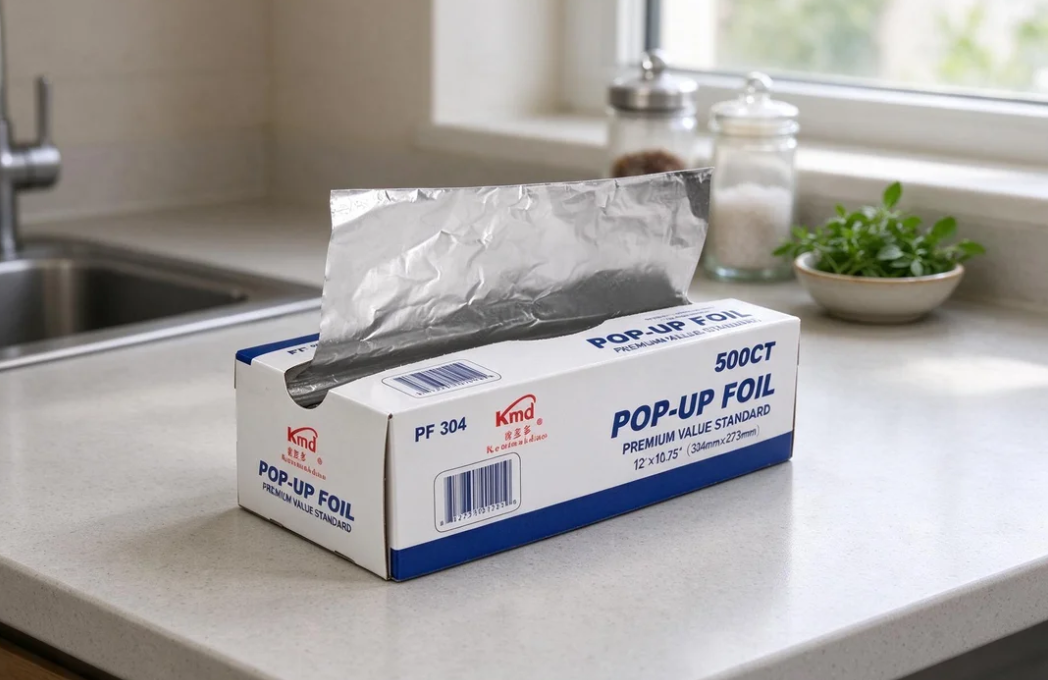
Common Specs of Interfolded Aluminum Foil Sheets: Length, Width, Folding Types & Pattern
Interfolded Aluminum foil sheets are widely used in food-service, household, catering, takeaway, and packaging applications where pre-cut and folded foil sheets offer a convenient alternative
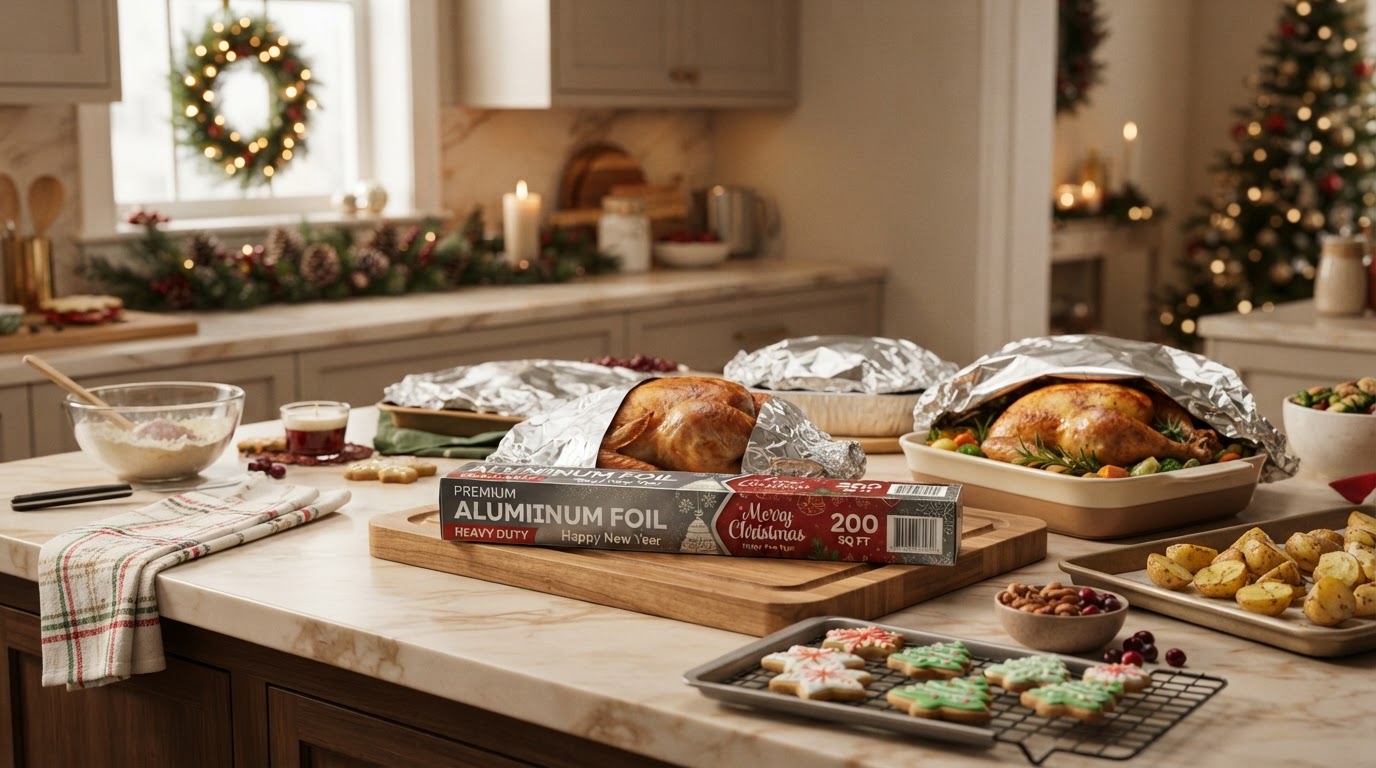
Aluminum Foil Sheet vs Foil Roll: Which One Is Right for Your Production
When sourcing aluminum foil, buyers often need to choose between aluminum foil sheets and aluminum foil rolls. Although both use aluminum foil as the basic
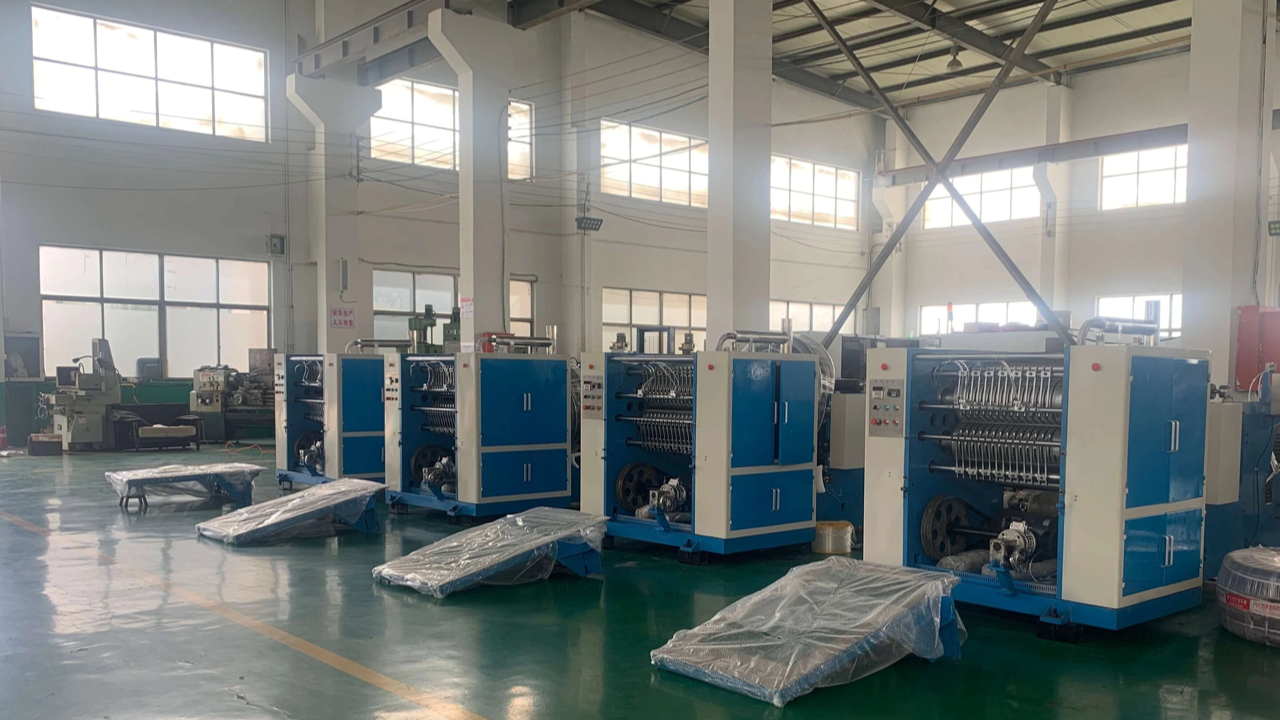
How to Make Aluminum Foil Interleaving Sheets – Machine and Production Guide
Starting an aluminum foil interleaving sheet production line can be a practical opportunity for manufacturers and distributors supplying foodservice, restaurants, bakeries, catering companies, and household

Household Aluminum Foil Seasonal Demand: BBQ, Thanksgiving & Holiday Trends
Household aluminum foil is a year-round product, but demand is not always the same throughout the year. Cooking habits, outdoor grilling, major holidays, retail promotions,
Tinplate Saw Blade Binding Machine: Complete Guide for Color Box Packaging
When you buy a box of household aluminum foil or cling film, you may notice a small metal cutting blade fixed to one edge of