If you purchase raw materials from the aluminum foil processing factory, you already know that aluminum foil is the backbone of modern food, pharmaceutical, and industrial packaging. For buyers, importers, and packaging manufacturers, mastering this process is essential.
Product quality does not start when a master coil is loaded onto a slitting machine. It begins deep in the earth and is refined through highly technical metallurgical processes.
By understanding the journey from bauxite to aluminum, you can make smarter purchasing decisions. You will know exactly what questions to ask your aluminum foil supplier, how to negotiate better pricing, and how to guarantee you are sourcing the exact material your production lines demand.
What Is the Aluminum Foil Supply Chain?
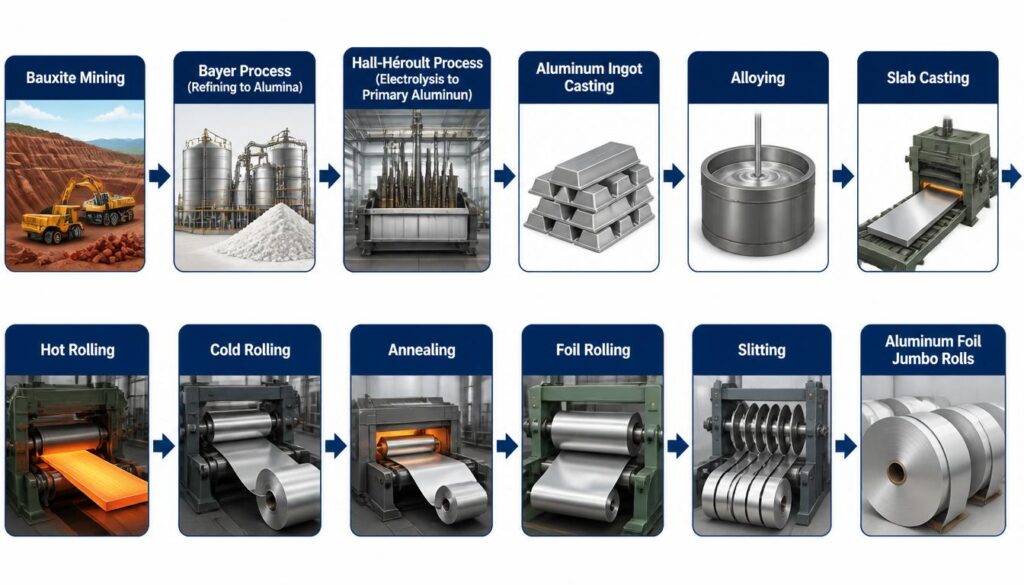
The aluminum foil supply chain is the complete sequence of processes that transform raw bauxite ore into the wide, heavy rolls of aluminum foil that converters use to make finished products.
Here’s the journey at a glance:
Step 1: Mining Bauxite – The Beginning of the Supply Chain
Every aluminum product starts with bauxite, the world’s primary source of aluminum.Bauxite is a naturally occurring sedimentary rock rich in aluminum oxides. It forms over millions of years through the weathering of rocks in tropical and subtropical climates.
Unlike finished aluminum, bauxite cannot be used directly. It must first be refined into alumina before aluminum metal can be produced.
Where Is Bauxite Mined?
Several countries dominate global bauxite production due to their abundant natural reserves.
Major bauxite-producing countries include:
- Australia
- Guinea
- China
- Brazil
- India
- Indonesia
Australia and Guinea together account for a significant share of global bauxite exports, supplying refineries and aluminum producers around the world.
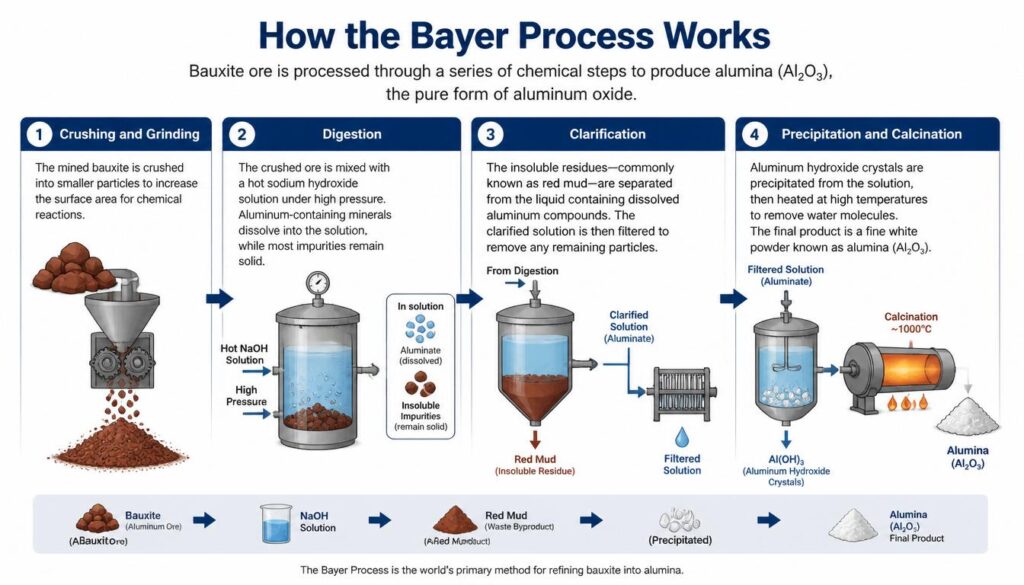
Step 2: Refining Bauxite into Alumina
After mining, bauxite is transported to alumina refineries, where it is converted into alumina (Al₂O₃)—the essential raw material used to produce aluminum metal.
This conversion is carried out using the Bayer Process, a refining method that has been widely adopted for over a century.
Why Alumina Is So Important
Alumina serves as the direct feedstock for aluminum smelters.
Its purity has a significant impact on:
- Aluminum purity
- Mechanical properties
- Rolling performance
- Surface quality
- Final foil consistency
For manufacturers producing food-grade aluminum foil, maintaining high-purity alumina throughout the process is essential to achieving stable product quality.
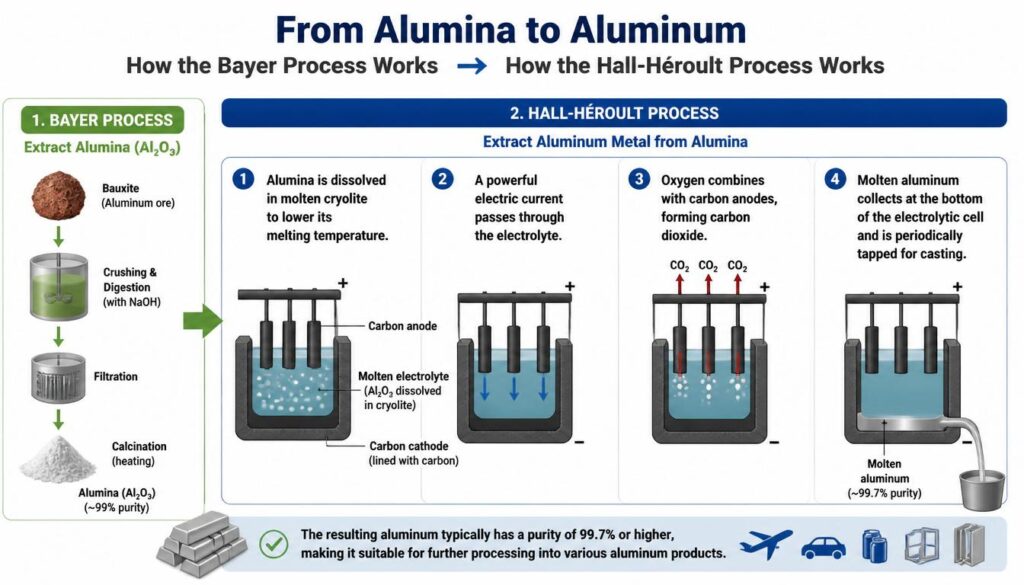
Step 3: Producing Primary Aluminum
Once alumina has been refined, the next step is converting it into pure aluminum metal. This is achieved through the Hall-Héroult Process, the world’s standard method for producing primary aluminum.
The process uses electricity to separate aluminum from oxygen in molten alumina. Because aluminum does not exist naturally in its metallic form, electrolysis is required to extract the pure metal.
From Molten Aluminum to Aluminum Ingots
After electrolysis, molten aluminum is cast into different forms depending on its intended application.
Common products include:
- Primary aluminum ingots
- Rolling slabs
- Billets
- Wire rods
For aluminum foil production, large rolling slabs are the preferred starting material because they can withstand multiple rolling stages while maintaining excellent structural consistency.
Primary Aluminum vs. Recycled Aluminum
Modern aluminum production increasingly incorporates recycled material, helping reduce both costs and carbon emissions.
| Primary Aluminum | Recycled Aluminum |
|---|---|
| Produced directly from alumina | Produced by remelting aluminum scrap |
| Higher purity | Quality depends on scrap sorting and refining |
| Excellent consistency | May require additional alloy adjustments |
| Preferred for demanding foil applications | Widely used in many industrial products |
For food-grade aluminum foil, many manufacturers use a carefully controlled combination of primary aluminum and high-quality recycled aluminum. Advanced refining and filtration technologies ensure the final composition meets strict industry standards while supporting sustainability goals.
Step 4: Alloying Aluminum for Different Foil Applications
Pure aluminum is relatively soft. To achieve the strength, formability, and performance required for different applications, manufacturers add controlled amounts of alloying elements such as:
- Iron (Fe)
- Silicon (Si)
- Manganese (Mn)
- Magnesium (Mg)
These elements create different aluminum alloys, each designed for specific end uses.
Selecting the right alloy is one of the most important decisions in aluminum foil production, as it determines the foil’s mechanical properties, forming performance, corrosion resistance, and suitability for various industries.
Aluminum Foil Alloy Comparison
| Alloy | Main Features | Typical Applications |
|---|---|---|
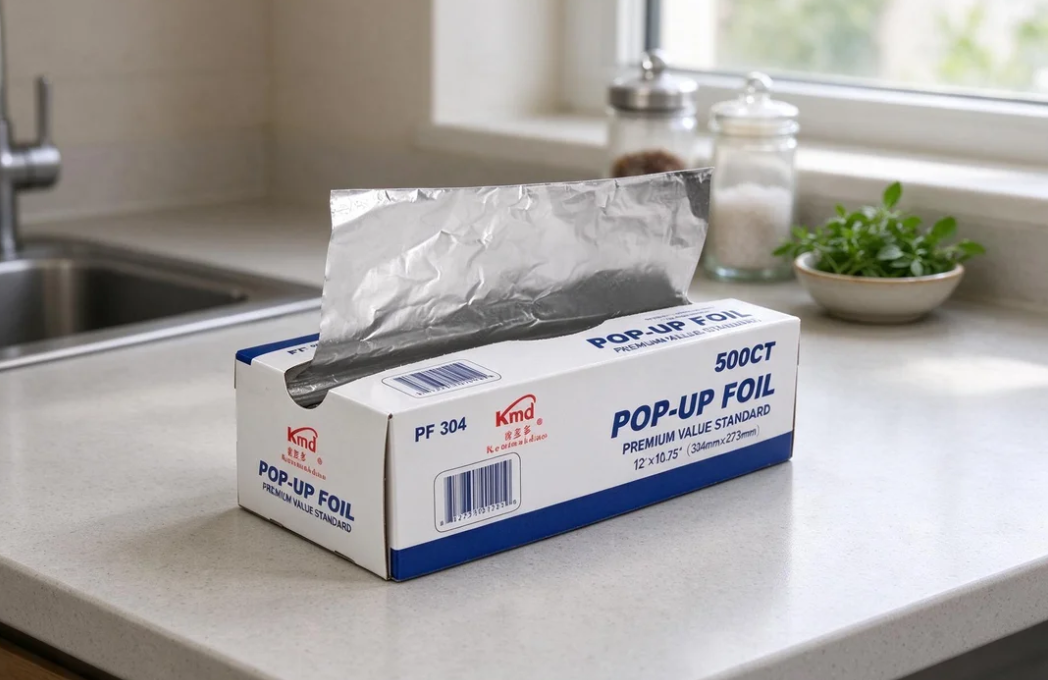
| 8011 | Excellent formability, corrosion resistance, food-safe | Household foil, food wrapping, pop-up sheets |
| 3003 | Higher strength, good deep drawing | Food containers, small trays |
| 3004 | Recycled aluminum foil scraps and tins | Heavy-duty containers, large trays |
| 8006 | Excellent elongation, wrinkle-free forming | Premium wrinkle-free foil containers |
| 8079 | Ultra-thin, highly flexible | Pharmaceutical foil, flexible packaging |
Choosing the Right Alloy
There is no single “best” aluminum foil alloy. The ideal choice depends on your product requirements.
When selecting an alloy, buyers should consider factors such as:
- Product design
- Container size
- Forming complexity
- Thickness
- Surface finish
- End-use industry
- Production equipment compatibility
For example:
- A household foil converter may prioritize the versatility of 8011.
- A food container manufacturer may choose 3003, 3004, or 8006 depending on the container design.
- A pharmaceutical packaging producer will often require 8079 for its superior barrier properties and flexibility.
Working closely with an experienced aluminum foil supplier can help ensure the selected alloy matches both your production process and your customers’ performance expectations.
Understanding these differences allows buyers to source more effectively, avoid unnecessary costs, and achieve consistent product quality over the long term.
Step 5: Rolling Aluminum into Foil
After the aluminum alloy has been cast into large slabs, the material enters the most critical stage of foil manufacturing: rolling.
The goal is to gradually reduce the aluminum from several hundred millimeters thick to a foil that may be only 0.006–0.2 mm thick.
This reduction cannot be achieved in a single step. Instead, manufacturers use a series of rolling processes with progressively tighter thickness control.
1. Hot Rolling
The cast slab is first heated and passed through large rolling mills.
Purpose of hot rolling:
Reduce slab thickness significantly
Improve internal structure
Eliminate casting defects
Prepare the material for cold rolling
After hot rolling, the material becomes a thick aluminum coil rather than a rigid slab.
2. Cold Rolling
The coil is then rolled at room temperature through multiple rolling stands.
Cold rolling provides:
More precise thickness control
Better surface finish
Improved flatness
Higher production consistency
Several rolling passes are usually required, with the thickness gradually reduced at each stage.
3. Foil Rolling
When the material becomes extremely thin, it enters the foil rolling stage.
At this point, the aluminum is often rolled two sheets together (known as double rolling) because a single sheet would be too fragile.
This process creates:
A bright side (contacting the polished roll)
A matte side (contacting the other foil sheet)
This is why many aluminum foil products have one shiny side and one dull side.
Step 6: Annealing and Surface Treatment
After rolling, the foil is usually too hard for many applications.
It therefore undergoes annealing, a controlled heat treatment process.
What Annealing Does
Annealing helps:
Restore softness
Improve ductility
Enhance deep drawing performance
Reduce internal stress
This step is especially important for food container foil, which must be formed into trays and containers without cracking.
Understanding O Temper and H Temper
Temper | Characteristics |
|---|---|
O Temper | Fully annealed, very soft, excellent formability |
H Temper | Strain-hardened, higher strength |
Cleaning and Food-Grade Requirements
During rolling, lubricants are used to reduce friction.
Before shipment, manufacturers carefully control:
Residual oil levels
Surface cleanliness
Odor
Food-contact compliance
For food packaging applications, cleanliness standards are particularly strict.
Step 7: Slitting into Aluminum Foil Jumbo Rolls
Once the foil reaches its final thickness and temper, it is slit into aluminum foil jumbo rolls.
These jumbo rolls are the raw material used by downstream converters.
Typical Jumbo Roll Specifications
Parameter | Typical Range |
|---|---|
Thickness | 0.006–0.2 mm |
Width | Custom according to application |
Inner diameter (ID) | 76 mm / 152 mm |
Outer diameter (OD) | Up to 800 mm or more |
Roll weight | Several hundred kilograms to several tons |
Final Quality Inspection
Before export, reputable suppliers typically inspect:
Thickness tolerance
Width tolerance
Tensile strength
Elongation
Surface defects
Pinhole count
Roll edge quality
Coil winding quality
Tips for Sourcing Aluminum Foil Jumbo Rolls from China
China is one of the world’s largest producers and exporters of aluminum foil. Many manufacturers supply high-quality jumbo rolls to customers in Europe, North America, the Middle East, Southeast Asia, and other international markets.
When selecting a supplier, consider the following:
- Verify manufacturing capabilities and production capacity.
- Confirm the supplier has experience with your target application.
- Request technical data sheets and quality certificates.
- Ask for product samples before placing large orders.
- Review packaging methods for international shipping.
- Ensure the supplier can provide consistent specifications over the long term.
If you are new to importing aluminum foil, working with an experienced sourcing partner can simplify supplier selection, quality inspection, logistics coordination, and communication.
Conclusion
The journey from bauxite to an aluminum foil jumbo roll involves far more than a simple rolling process. Each stage—from mining and refining to alloying, rolling, annealing, and slitting—plays a critical role in determining the foil’s final quality and performance.
Understanding this supply chain provides valuable insight into how raw material quality, manufacturing expertise, and process control influence the finished product. It also makes it easier to evaluate suppliers, select the right alloy, and reduce sourcing risks.
Whether you manufacture aluminum foil containers, household foil, dairy packaging, or other foil-based products, partnering with a supplier that understands every stage of the production process can help ensure consistent quality, competitive pricing, and reliable delivery.
For a practical, buyer-focused framework that connects supply chain understanding to everyday sourcing and quality decisions, turn to our Aluminum Foil Raw Materials: The Complete Guide for Packaging Manufacturers and Buyers.
FAQ Section
Where does aluminum foil come from?
Aluminum foil originates from bauxite ore, which is mined from the earth. Through a series of refining and smelting processes, this earth is turned into alumina, then liquid aluminum, and finally solid ingots that are rolled into foil.
What raw material is used to make aluminum foil?
The primary raw material is high-purity aluminum ingot, which is melted down and alloyed with small amounts of other metals like iron, manganese, and silicon to improve strength and formability.
How thin is aluminum foil?
Industrial aluminum foil can range from 200 microns (heavy-duty container foil) all the way down to a microscopic 5 or 6 microns (ultra-thin flexible packaging foil).
What is an aluminum foil jumbo roll?
A jumbo roll is a massive, tightly wound coil of aluminum foil produced by a mill. These rolls can weigh hundreds of kilograms and are sold B2B to packaging factory, who then slit, stamp, or laminate the material into finished consumer products.
Which alloy is best for food containers?
Alloy 3003 and 8011 are the industry standards for food containers. 3003 offers excellent strength for food takeout trays, while 8011 is highly versatile and economical for standard household containers.
Is recycled aluminum used in foil production?
Yes, the aluminum industry heavily utilizes recycled scrap. However, for ultra-thin packaging foil, mills generally rely on primary (new) aluminum. High purity is required to prevent impurities that cause pinholes or web breaks during the high-speed rolling process.
Share:
Related Posts

Aluminum Foil Raw Materials: The Complete Guide for Packaging Manufacturers and Buyers
Aluminum foil has become one of the most important materials in modern packaging. From disposable food containers and household kitchen foil to pharmaceutical blister packs

The Aluminum Foil Supply Chain Explained: From Bauxite Mining to Jumbo Roll Production
If you purchase raw materials from the aluminum foil processing factory, you already know that aluminum foil is the backbone of modern food, pharmaceutical, and

How to Measure Aluminum Foil Thickness: Micrometer vs. Gravimetric Method (Complete Guide)
Aluminum foil thickness is one of the most important quality indicators in the foil manufacturing. Whether the foil is used for food containers, household foil

8006 O Aluminum Foil: The Best Choice for Wrinkle-Free Aluminum Foil Containers
Walk down any packaged food aisle or open an airline meal tray, and you’ll see aluminum foil containers of vastly different quality. Premium ones feature

8011 O Aluminum Foil Jumbo Rolls: Features, Thickness, Width and Common Applications
Household aluminum foil has become an essential product in modern kitchens, widely used for food wrapping, baking, grilling, freezing, and food storage. Behind every finished