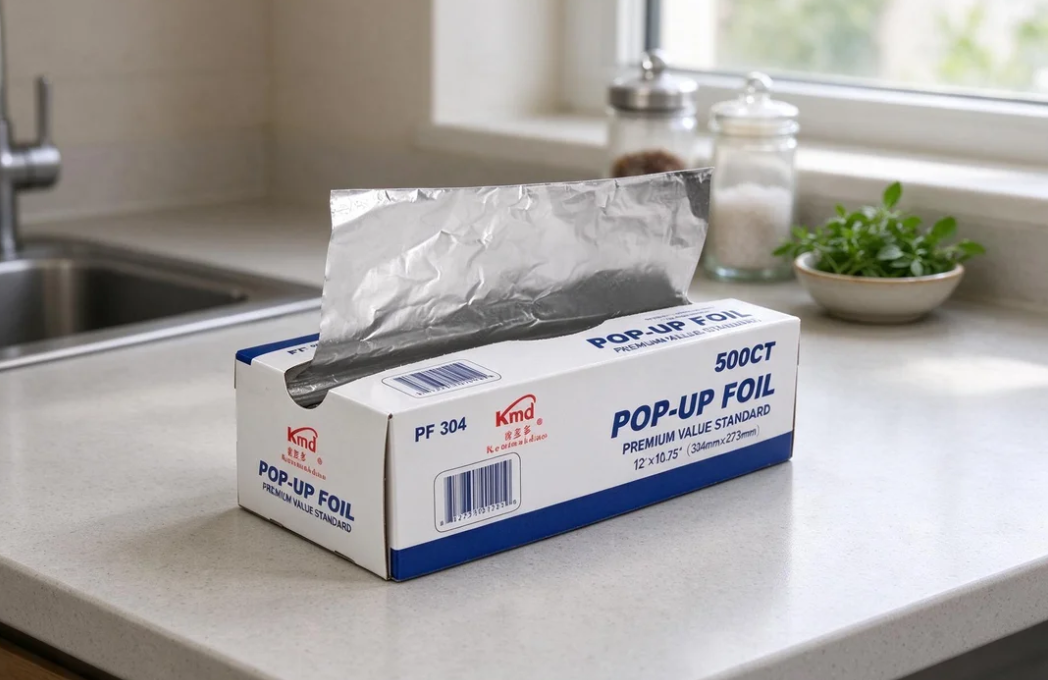
Aluminum foil thickness is one of the most important quality indicators in the foil manufacturing. Whether the foil is used for food containers, household foil rolls or pharmaceutical packaging, even a slight variation in thickness can affect product performance, production efficiency, and manufacturing costs.
For manufacturers, maintaining consistent foil thickness ensures stable forming performance, reliable sealing, and efficient material utilization. For buyers, accurate thickness verification helps confirm that the supplied material meets contract specifications and industry standards.
In this guide, we’ll explain the two most widely used techniques for aluminum foil thickness measurement—the micrometer method and the gravimetric (weight) method. You’ll learn how each method works.
Common Units for Measuring Aluminum Foil Thickness
Before discussing measurement methods, it’s helpful to understand the units commonly used in the aluminum foil industry.
Although different countries and industries may use different units, they all describe the same physical thickness.
Micron (μm)
The micron, also called the micrometer (μm), is the most widely used unit for aluminum foil thickness.
One micron equals:
1 μm = 0.001 mm=1 micron
Most aluminum foil products fall within the following ranges:
| Application | Typical Thickness |
|---|---|
| Household aluminum foil | 9–20 μm |
| Pop-up foil sheets | 10–18 μm |
| Hairdressing foil | 12–20 μm |
| Pharmaceutical foil | 20–25 μm |
| Food container foil | 30–80 μm |
| Heavy-duty aluminum foil | 35–90 μm |
Millimeter (mm)
Some engineering drawings and production documents express thickness in millimeters.
For example:
- 0.030 mm = 30 μm
- 0.040 mm = 40 μm
- 0.060 mm = 60 μm
Because both units are commonly used, manufacturers often convert between millimeters and microns during production and quality inspection.
Gauge
In North America, aluminum foil thickness is sometimes referred to by gauge. However, gauge is not an international standard and may vary depending on the material and industry.
For this reason, most international suppliers and buyers prefer specifying thickness in microns (μm) or millimeters (mm) to avoid confusion.
Why Unit Consistency Matters
Misunderstanding thickness units can lead to purchasing errors or production issues. For example, confusing 0.03 mm with 0.3 mm results in a tenfold difference in material thickness.
To avoid costly mistakes:
- Clearly state the unit on purchase orders.
- Confirm thickness in both μm and mm when necessary.
- Verify customer specifications before production begins.
- Use calibrated measuring instruments during inspection.
With a clear understanding of thickness units, the next step is learning how to measure aluminum foil accurately. In the following section, we’ll examine the micrometer method, the most commonly used technique in factories for routine quality control, before comparing it with the gravimetric method, which is often preferred for laboratory verification and ultra-thin foil testing.
Method 1: Measuring Thickness with a Micrometer
What Is a Micrometer?
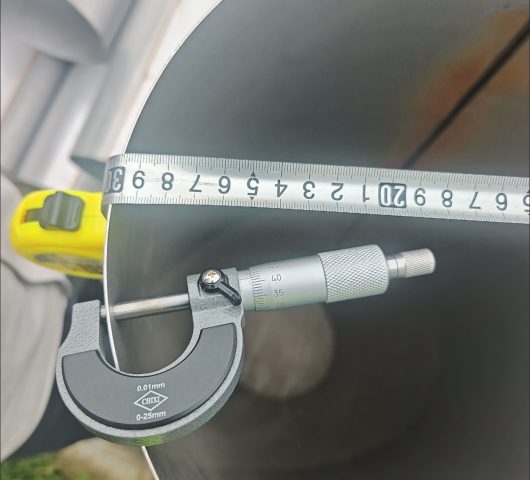
A micrometer is a precision measuring instrument designed to measure extremely small dimensions with high accuracy. Digital micrometers are widely used in modern factories because they provide quick readings and reduce human reading errors.For aluminum foil inspection, a digital micrometer with a resolution of 0.001 mm (1 μm) is generally recommended.
Typical measuring range:
- Resolution: 0.001 mm (1 μm)
- Accuracy: ±1–2 μm
- Measuring force: Constant-force ratchet recommended
Using excessive pressure during measurement may compress the foil and produce readings that are lower than the actual thickness.
Step-by-Step Measuring Process
Clean the micrometer anvils. Any debris or oil will affect the reading.
Calibrate the instrument. Check against a calibration standard before each measurement session.
Select your sample. Cut a piece of foil large enough to fit comfortably between the anvils. Avoid edges, which may be damaged or uneven.
Place the foil between the anvils. Position it flat and smooth—no wrinkles, no folds.
Close the micrometer gently. Turn the ratchet until you feel light resistance. Do not force it. Excessive pressure compresses the foil and gives a false reading.
Take the reading. Record the value.
Repeat at multiple points. Foil thickness varies across the width and length of a roll. Measure at least 5–10 points.
Common Mistakes to Avoid
Many measurement errors are caused by incorrect operating habits rather than instrument accuracy.
Avoid these common mistakes:
- Measuring folded foil
- Measuring near damaged edges
- Applying excessive pressure
- Using an uncalibrated micrometer
- Measuring dirty or oily surfaces
- Recording only one measurement point
Instead, measure several locations and calculate the average thickness whenever possible.
Method 2: Measuring Aluminum Foil Thickness Using the Gravimetric Method
The gravimetric method, also known as the weight method, determines foil thickness by calculating it from the sample’s mass, area, and aluminum density.
Unlike the micrometer method, this technique does not physically compress the foil, making it particularly useful for very thin aluminum foil, laboratory verification, and reference testing.
Many quality control laboratories use the gravimetric method to verify measurement accuracy or resolve disputes between suppliers and buyers.
Equipment Required
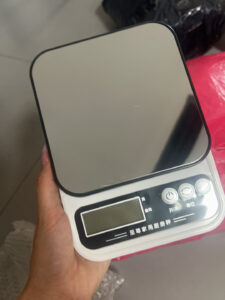
Precision balance. Accurate to at least 0.001 grams (1 mg). For very thin foils, a microbalance may be necessary.
Sample cutter. A precision blanking press or circular cutter to cut specimens of known area.
Ruler or caliper. For measuring dimensions if using a rectangular sample.
Clean work surface. Any contamination affects mass.
Principle of the Gravimetric Method
The calculation is based on a simple physical relationship:
Thickness = Weight ÷ (Density × Area)
Since the density of aluminum is relatively constant, measuring the sample’s weight and area allows the foil thickness to be calculated accurately.
For industrial applications, the density of aluminum is generally taken as:2.71g/cm³
Step-by-Step Calculation
Let’s walk through a real example.
Step 1: Cut your sample.
Suppose you have a 450 cutting size sample,you know the single cavity area is 33000mm² from the supplier.
Step 2: Weigh the sample.
Place the sample on the precision scale. Record the weight.
Let’s say 450 weight = 2.7 grams.
Step 3: Apply the formula.
Aluminum Foil Density=2.71
Thickness = Weight ÷ (aluminum density × Area)
T = 2.7g÷ (2.71 × 33000mm²)
T = 2.7 ÷ 89430
T = 0.000030
Step 4: Convert to mm.
0.000030cm × 1000 = 0.030mm
So your foil is approximately 0.03mm(30micron)thick
Understanding Aluminum Foil Thickness Tolerance
Measuring thickness is only part of the inspection process. Equally important is determining whether the measured value falls within the specified thickness tolerance.
Because no rolling process can produce perfectly uniform foil, every product is manufactured with an allowable variation.
For example, a customer specification may require:
- Nominal thickness: 40 μm
- Permissible tolerance: ±2 μm
This means acceptable measurements range from 38 μm to 42 μm.
If the measured thickness falls outside this range, the material may not meet the purchase specification.
Best Practices for Accurate Thickness Measurement
Whether you use a micrometer or the gravimetric method, these practices will improve your results.
Avoid measuring embossed areas. Embossing changes the local thickness. Measure only flat, untextured surfaces.
Keep measuring surfaces clean. Even microscopic debris affects readings. Clean anvils and sample cutters regularly.
Measure multiple points. Foil thickness varies across the roll. Measure at least 5–10 positions across the width and at several points along the length.
Calibrate instruments regularly. Micrometers drift. Balances need periodic calibration. Follow the manufacturer’s recommendations.
Record inspection data. Document every measurement. Track trends over time. This data helps identify process drift before it becomes a problem.
Use certified reference standards. When available, use certified thickness standards to verify your measurement system.
Train your operators. Technique matters. Ensure everyone who performs measurements follows the same procedure
Conclusion
Accurate thickness measurement is fundamental to quality control—whether you choose the precision of a micrometer or the statistical reliability of the gravimetric method.
But thickness is just one quality parameter among many. Tensile strength, elongation, pinhole count, and surface cleanliness all require equally rigorous attention.
A comprehensive quality assurance program integrates all these measurements into a coherent specification framework tailored to your end-use applications.
To see how thickness measurement fits into the bigger picture of material selection and supplier evaluation, read the complete Aluminum Foil Raw Material: The Complete Guide for Packaging Manufacturers and Buyers.
FAQ Section
Can a digital caliper measure aluminum foil thickness?
Not effectively. Digital calipers lack the precision and consistent pressure needed for foil measurement. They’re designed for thicker materials. Use a micrometer or the gravimetric method instead.
Which method is more accurate—micrometer or gravimetric?
The gravimetric method is more accurate, especially for thin foils. With a precision balance, gravimetric accuracy within ±0.5 microns is achievable.
How many samples should be tested?
For incoming inspection, test at least 3–5 samples from different positions on the roll. For production quality control, test at regular intervals—every coil, every shift, or according to your quality plan. ASTM standards typically recommend multiple specimens to account for thickness variation.
Why do measurements vary across the same roll?
Rolling mills don’t produce perfectly uniform foil. Thickness varies from edge to center (crown) and along the length due to roll deflection, tension variations, and thermal effects. This is normal—which is why tolerances exist and multiple measurements are necessary.
What is the standard thickness of household aluminum foil?
Standard household foil typically ranges from 10 to 18 microns. Heavy-duty household foil ranges from 18 to 24 microns.
Can I measure foil thickness by weighing a full roll?
Yes, but indirectly. By knowing the roll’s width, length, and total weight, you can calculate average thickness. This is essentially the gravimetric method applied to the entire roll rather than a sample. It gives a roll-average thickness but doesn’t reveal local variations.
Share:
Related Posts

Aluminum Foil Raw Materials: The Complete Guide for Packaging Manufacturers and Buyers
Aluminum foil has become one of the most important materials in modern packaging. From disposable food containers and household kitchen foil to pharmaceutical blister packs

The Aluminum Foil Supply Chain Explained: From Bauxite Mining to Jumbo Roll Production
If you purchase raw materials from the aluminum foil processing factory, you already know that aluminum foil is the backbone of modern food, pharmaceutical, and

How to Measure Aluminum Foil Thickness: Micrometer vs. Gravimetric Method (Complete Guide)
Aluminum foil thickness is one of the most important quality indicators in the foil manufacturing. Whether the foil is used for food containers, household foil

8006 O Aluminum Foil: The Best Choice for Wrinkle-Free Aluminum Foil Containers
Walk down any packaged food aisle or open an airline meal tray, and you’ll see aluminum foil containers of vastly different quality. Premium ones feature

8011 O Aluminum Foil Jumbo Rolls: Features, Thickness, Width and Common Applications
Household aluminum foil has become an essential product in modern kitchens, widely used for food wrapping, baking, grilling, freezing, and food storage. Behind every finished