If you’re sourcing aluminum foil for container manufacturing, you’ve likely encountered the debate: 3003 H24 or 8011 H22? Both are widely used in the food packaging industry, but they serve different purposes and perform differently under the press.
Here’s the honest answer that frustrates most buyers: neither alloy is inherently superior. The right choice depends entirely on your specific application, production volume, target market, and container design.
Let’s break down what these designations actually mean, how the two alloys compare on the shop floor, and which one makes sense for your operation.
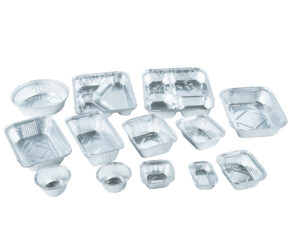
Products made by 3003 H24
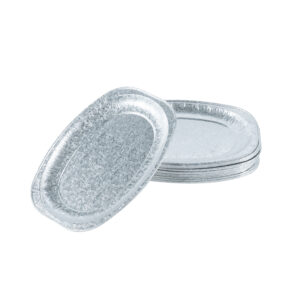
Products made by 8011 H22
3003 H24 vs 8011 H22 Aluminum Foil Comparsion
What Does 3003 H24 Mean?
To understand 3003 H24, you need to look at both the alloy number and the temper designation separately.
3003 is a 3xxx series aluminum alloy. Its primary alloying element is manganese (Mn), typically 1.0–1.5%. The alloy also contains small amounts of copper (0.05–0.20%), silicon (up to 0.6%), and iron (up to 0.7%), with the remainder being aluminum.
This manganese addition gives 3003 several distinctive characteristics:
- Medium strength – stronger than 1000 series pure aluminum alloys
- Excellent corrosion resistance – the manganese helps form a protective oxide layer
- Good weldability and formability – suitable for various manufacturing processes
- Higher elongation compared to 1000 series and even 8011
H24 is the temper designation. The “H” indicates strain-hardened (work-hardened). The first digit “2” means strain-hardened and partially annealed. The second digit “4” indicates a specific level of strength—in this case, three-quarters hard.
What does H24 mean in practical terms? It is a partially annealed temper that balances strength and ductility. The foil has been work-hardened and then given a partial anneal to restore some formability while retaining most of the strength from cold working.
For 3003 H24 aluminum foil, typical mechanical properties are:
- Tensile strength: 140–170 MPa
- Yield strength: ≥85 MPa
- Elongation: approximately 9% (A50mm)
- Hardness: approximately 48 HB
Typical applications for 3003 H24 include small and middle-sized food containers like india 250,450,660 750 or Middle East 8342,8389,82120 etc.
What Does 8011 H22 Mean?
8011 is an 8xxx series aluminum alloy. Unlike 3003, which uses manganese as its primary alloying element, 8011 is alloyed primarily with iron (Fe) and silicon (Si).
Typical composition ranges are:
- Silicon: 0.50–0.90%
- Iron: 0.60–1.0%
- Copper: ≤0.10%
- Manganese: ≤0.20%
- Remainder aluminum
This Fe-Si composition makes 8011 significantly less expensive to produce than 3003. The alloying elements are abundant and inexpensive, and the alloy responds well to high-speed rolling.
H22 is the temper designation. Similar to H24, the “H” indicates strain-hardened. The first digit “2” means strain-hardened and partially annealed. The second digit “2” indicates a quarter-hard condition—meaning 8011 H22 is slightly softer and more formable than 8011 H24.
For 8011 H22 aluminum foil, typical mechanical properties are:
- Tensile strength: 90–150 MPa
- Elongation: 1.0–6.0% (depending on thickness)
8011 foil is highly malleable, ductile, and lightweight, with excellent barrier properties against light, moisture, and environmental factors.
Typical applications for 8011 H22 include foil container like middle east fish plate,US full size pan,half size pan or oval roast pan etc..
Side-by-Side Comparison Table
| Property | 3003 H24 | 8011 H22 |
|---|---|---|
| Alloy Series | 3xxx (Al-Mn) | 8xxx (Al-Fe-Si) |
| Main Alloying Elements | Mn 1.0–1.5%, Cu 0.05–0.20% | Fe 0.6–1.0%, Si 0.50–0.90% |
| Temper | H24 (3/4 hard, partially annealed) | H22 (1/4 hard, partially annealed) |
| Tensile Strength | 140–170 MPa | 90–150 MPa |
| Yield Strength | ≥85 MPa | Lower than 3003 |
| Elongation | ~9% (A50mm) | 1.0–6.0% (depending on thickness) |
| Deep Drawing Performance | Excellent; preferred for complex shapes | Good for standard shapes; may crack on deep draws |
| Formability | Good | Very good for standard applications |
| Corrosion Resistance | Superior; better for acidic/salty foods | Good for most food applications |
| Heat Resistance | Withstands up to 300°C without deformation | Suitable up to ~230°C |
| Surface Quality | Good | Good; excellent for lacquering |
| Food Safety | Food grade; meets international standards | Food grade; widely used |
| Recyclability | 100% recyclable; infinite recycling without quality loss | 100% recyclable |
| Cost | Higher ($2.5–3.0/kg range) | Lower |
| Typical Container Applications | India 250,450,660 750 or Middle East 8342,8389,82120 etc,widely for lightweight household trays or standard takeaway containers with relatively shallow forming depths. | Middle East fish plate,US full size pan,half size pan,oval roast,rectangle pan,particularly in larger tray sizes or products designed to carry heavier foods. |
Common Mistakes Buyers Make When Selecting Aluminum Foil
Over the years, I have seen the same mistakes repeated by buyers sourcing aluminum foil for container manufacturing. Here are the most common ones:
Choosing alloy based only on price – The per-ton price difference can be misleading. Factor in scrap rate, production efficiency, and reject rates before making a decision.
Ignoring temper – H22 and H24 are not interchangeable. H22 is softer and more formable; H24 is stronger and more rigid. Choose the temper that matches your container design and production process.
Using the wrong alloy for deep drawing – If your container requires deep drawing, 8011 may crack at corners. Test before committing to large orders.
Overlooking supplier consistency – Small mills often produce foil that breaks easily due to loose alloy control or poor rolling processes. Work with reputable suppliers who maintain consistent quality.
Ignoring pinhole quality – Pinholes can compromise food safety and container integrity. Ask your supplier about pinhole counts and testing methods.
Ignoring elongation requirements – Elongation is critical for formability. Higher elongation means less cracking during stamping. Do not focus solely on tensile strength.
Assuming both alloys are food-safe without verification – Both can be food-grade, but confirm your supplier’s foil meets FDA, EU, or other relevant food contact standard
Conclusion
The choice between 3003 H24 and 8011 H22 aluminum foil for food containers is not about which alloy is “better” in absolute terms—it is about which alloy is better for your specific application.
3003 H24 offers higher strength, superior corrosion resistance, and better performance for deep-draw and complex container designs. It is the preferred choice for premium food packaging, export containers, and any application where container rigidity and durability are critical.
8011 H22 provides excellent formability at a lower cost, making it the industry standard for large heavy duty containers.
The key is understanding your container design, production process, and quality requirements—then selecting the alloy that optimizes your total manufacturing cost, not just your raw material cost per ton.
For a comprehensive comparison of all major foil alloys and their applications, consult our Aluminum Foil Raw Materials: The Complete Guide for Packaging Manufacturers and Buyers.
Frequently Asked Questions
Is 3003 stronger than 8011?
Yes, 3003 has higher tensile strength (140–170 MPa for 3003 H24 vs. 90–150 MPa for 8011 H22) and higher yield strength. 3003 is also stronger than 8011 for most structural applications.
Can 8011 replace 3003?
It depends on the application. For shallow, standard heavy duty containers, 8011 can replace 3003 with cost savings. For deep-draw, complex containers, 8011 may not perform adequately. Test your specific container design before making a substitution.
Which alloy is better for deep drawing?
3003 is generally better for deep drawing due to its higher strength and elongation. However, some sources note 8011 demonstrates superior formability for deep drawing processes in certain applications. The specific temper and container geometry matter significantly.
Is 3003 more expensive than 8011?
Yes, 3003 typically costs 5–10% more than 8011 for equivalent thicknesses. The price difference comes from the manganese content in 3003 versus the less expensive iron and silicon in 8011.
Can both alloys be recycled?
Yes, both 3003 and 8011 are 100% recyclable and can be recycled indefinitely without losing quality.
Which alloy is recommended for high-speed production lines?
Both alloys can run on high-speed lines. 8011 is more common for high-volume production of standard containers due to lower cost and good rolling characteristics. 3003 requires more pressing force but runs efficiently on properly specified equipment.
Which alloy is better for acidic foods?
3003 performs better with acidic foods due to its manganese content, which provides superior corrosion resistance. 8011 may develop microscopic pinholes over long shelf life with acidic foods.
What thickness should I use for food containers?
Most food containers are made between 0.028mm and 0.12mm thickness, depending on container size and design. Small containers use 0.028–0.06mm; general disposable trays use 0.07–0.08mm; large heavy duty trays use 0.09–0.10mm
Share:
Related Posts

Aluminum Foil Raw Materials: The Complete Guide for Packaging Manufacturers and Buyers
Aluminum foil has become one of the most important materials in modern packaging. From disposable food containers and household kitchen foil to pharmaceutical blister packs

The Aluminum Foil Supply Chain Explained: From Bauxite Mining to Jumbo Roll Production
If you purchase raw materials from the aluminum foil processing factory, you already know that aluminum foil is the backbone of modern food, pharmaceutical, and

How to Measure Aluminum Foil Thickness: Micrometer vs. Gravimetric Method (Complete Guide)
Aluminum foil thickness is one of the most important quality indicators in the foil manufacturing. Whether the foil is used for food containers, household foil

8006 O Aluminum Foil: The Best Choice for Wrinkle-Free Aluminum Foil Containers
Walk down any packaged food aisle or open an airline meal tray, and you’ll see aluminum foil containers of vastly different quality. Premium ones feature

8011 O Aluminum Foil Jumbo Rolls: Features, Thickness, Width and Common Applications
Household aluminum foil has become an essential product in modern kitchens, widely used for food wrapping, baking, grilling, freezing, and food storage. Behind every finished