
When planning an aluminum foil container factory, most investors focus on the machine, mold, and raw material costs. However, one critical piece of equipment is often overlooked—the air compressor.
From what we’ve seen in many factory setups, a reliable air compressor is just as important as the aluminum foil container machine itself. Without stable compressed air, many automatic functions simply cannot operate properly.
Whether you are building a new foil container factory or expanding an existing production line, understanding the role of air compressors can help improve production efficiency, reduce downtime, and protect your investment.
Major Content:
- What Does an Air Compressor Do?
- Why Aluminum Foil Container Machines Need Compressed Air?
- How Air Pressure Affects Production Stability?
- How to Choose the Right Air Compressor?
- Common Types of Air Compressors Used in Factories
- Air Treatment Equipment Is Equally Important
- Air Compressor Maintenance Tips
- FAQ Section
What Does an Air Compressor Do?
An air compressor converts electrical energy into compressed air — stored potential energy that can do work throughout your factory. Think of it as a battery for pneumatic power.
In simple terms, the compressor draws in ambient air, compresses it to reduce its volume, and stores it under pressure in a tank. When your production line needs power for pneumatic components, that stored energy is released.
Why is this important? Because in industrial production, compressed air is often called the “fourth utility” — right after electricity, water, and natural gas.
Most aluminum foil container factories rely heavily on pneumatic systems. Without compressed air, the machine becomes a very expensive metal frame.
Why Aluminum Foil Container Machines Need Compressed Air?
Your foil container production line is not entirely electric. Many critical functions inside the machine depend on a pneumatic system powered by compressed air.
Here are the specific operations that require compressed air:
Material Feeding Mechanisms
Pneumatic cylinders help guide and position the aluminum foil as it feeds into the machine. Without consistent air pressure, the foil can misalign.
Mold Air Blowing Systems
After each container is formed, compressed air helps release the product from the mold. This is critical for preventing sticking and deformation.
Pneumatic Cylinders
These are the workhorses of the machine. They control punches, cutters, and forming stations. Each cylinder requires reliable air pressure to move precisely.
Product Ejection Systems
Once a container is formed, compressed air ejects it from the mold station onto the conveyor or stacking system.
Automatic Stacking Systems
Most modern aluminum foil container production lines include automated stackers that count and stack finished products. These stackers are almost always pneumatic.
Here’s the reality: without sufficient air pressure, your machine may still run — but it will run poorly. Feeding errors increase, containers stick in molds, stacks collapse, and production speed drops.
How Air Pressure Affects Production Stability?
Let me be specific about what happens when your compressed air system is inadequate.
Insufficient Air Pressure Causes:
Feeding Errors – The foil advances unevenly, causing misfeeds that stop production while an operator clears the jam.
Product Deformation – When ejection pressure is too low, containers stick in the mold. Operators may damage products trying to remove them.
Stacking Failures – Pneumatic stackers require precise timing and pressure. Low pressure means incomplete stacks or containers scattered across the conveyor.
Reduced Production Speed – Your machine may be rated for 40 cycles per minute, but with poor air supply, you might only achieve 25. That’s a 37% production loss.
Increased Downtime – Every pressure-related failure requires operator intervention. Some problems require stopping the entire line.
Inconsistent Quality – When air pressure fluctuates, every container may come out slightly different. Thickness variations, incomplete forming, and edge curling become common.
The Hidden Cost of Unstable Air
Beyond obvious production problems, unstable air pressure damages your machine over time. Pneumatic components forced to operate outside their designed pressure range wear faster. Cylinders fail prematurely. Valves stick. Seals leak.
I’ve seen factories replace entire pneumatic systems within 18 months simply because they never addressed their compressed air quality issues.
How to Choose the Right Air Compressor?
Selecting an industrial air compressor for your foil container factory requires understanding several key factors. Do not guess on these specifications.
Air Consumption (CFM or m³/min)
Different machines require different air volumes. A single small foil container machine might need 0.5–1.0 m³/min. A large production line with automatic stackers and multiple stations could require 2–3 m³/min or more.
Critical advice: Always request air consumption data from your machine supplier. Get it in writing. Then add 30–50% margin for future expansion and peak demand.
Working Pressure (PSI or bar)
Most aluminum foil container production lines operate at 6–8 bar (87–116 PSI). This is standard industrial pressure. Your compressor must deliver this pressure consistently at the required flow rate.
Important distinction: A compressor rated for 8 bar at zero flow may only deliver 5 bar at your actual air consumption. Pay attention to the pressure-flow curve.
Future Expansion
Are you starting with one machine but plan to add two more next year? If yes, buy a compressor sized for three machines now. Adding a second compressor later is possible but less efficient and more expensive than buying larger upfront.
Continuous Operation Rating
Factory compressors often run 16–24 hours per day. Many small compressors are rated for intermittent duty only. Running them continuously leads to overheating, oil breakdown, and premature failure.
Look for: 100% continuous duty rating.
Voltage and Phase
Most industrial compressors require three-phase power. If your factory doesn’t have three-phase, you need to factor in either a phase converter or select a single-phase compressor.
Common Types of Air Compressors Used in Factories
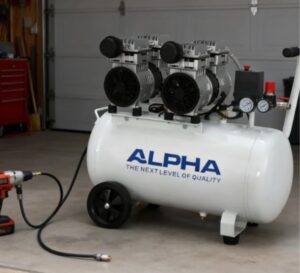
Piston Air Compressors (Reciprocating)
Pros:❶Lower initial purchase cost.❷Simple design, easy to repair.❸Widely available.
Cons:❶Higher noise levels.❷More vibration.❸Shorter duty cycle (needs rest periods).❹Higher maintenance frequency.❺Less energy efficient.
Best for: Very small operations with one machine running part-time.
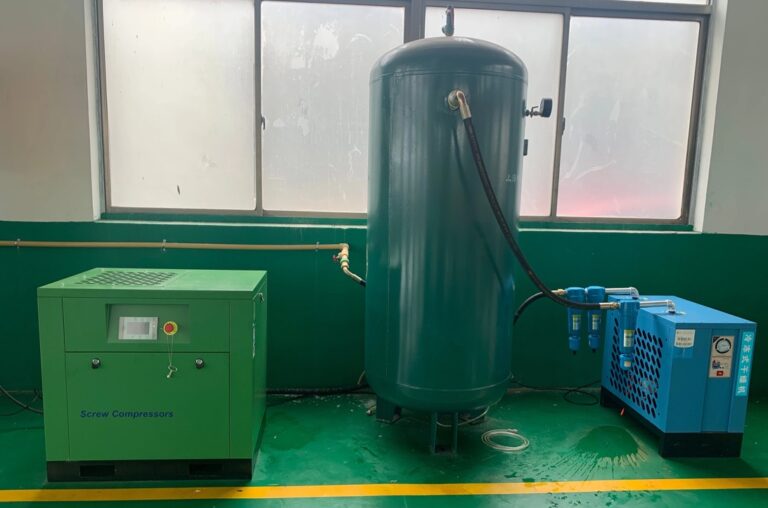
Screw Air Compressors (Rotary Screw)
Pros:❶Continuous duty rating.❷Much quieter operation.❸Lower vibration.❹Better energy efficiency (30%+ savings).❺Longer service intervals.❻More stable pressure output.
Cons:❶Higher upfront investment.❷More complex internal components.
Best for: Any medium to large foil container factory running multiple machines or extended shifts.
What I Recommend
For most aluminum foil container production line setups, choose a screw compressor. The higher initial cost pays back through energy savings and reduced downtime within 12–24 months. Piston compressors are false economy for serious production.
Air Treatment Equipment Is Equally Important
Many buyers focus only on the compressor itself and ignore the air treatment system.This can be a costly mistake.
Compressed air should be clean and dry before entering pneumatic components.
A complete compressed air system usually includes:
- Air compressor
- Air storage tank
- Air dryer
- Air filters
- Air piping system
Moisture and contaminants inside compressed air can damage valves, cylinders, and other pneumatic components.
Investing in proper air treatment equipment helps reduce maintenance costs and extend equipment lifespan.
Air Compressor Maintenance Tips
Proper maintenance is essential for reliable operation.Recommended maintenance practices include:
Daily Checks
Check oil level (for oil-lubricated compressors)
Drain moisture from receiver tank and filters
Listen for unusual noises or vibration
Verify operating pressure
Weekly Checks
Inspect for air leaks (listen, or use soapy water on fittings)
Check belt tension on piston compressors
Clean intake air filters
Monthly Checks
Change air filters (or clean if reusable)
Inspect hoses and fittings for wear
Check safety valve operation
Test condensate drains
Quarterly/Annual Maintenance
Change compressor oil and oil filter
Inspect and replace air-oil separator (screw compressors)
Check and clean cooler
Professional inspection of pressure vessel
Air Compressors Are Part of a Complete Factory Setup
When budgeting for an aluminum foil container production line, investors should include more than just the machine and mold.
A complete factory setup may include:
- Aluminum foil container machine
- Molds
- Air compressor
- Air storage tank
- Air dryer
- Scrap baler
- Forklift
- Raw material storage area
- Finished product storage area
Many first-time buyers forget to account for these supporting systems during project planning.As a result, installation delays and unexpected costs may occur.Proper planning from the beginning helps avoid these issues.
Conclusion
Air compressors play a vital role in aluminum foil container manufacturing.They provide the compressed air needed for feeding systems, pneumatic cylinders, product ejection, and automatic stacking functions.
For investors planning a new aluminum foil container factory, choosing the right compressed air system should be considered just as important as selecting the machine itself.
From what we’ve seen in many factory projects, air compressors are often overlooked, yet they play a critical role in maintaining stable production. To understand every essential component required for a successful factory, visit our The Complete Guide to Starting an Aluminum Foil Container Manufacturing Business.
FAQ Section
Why does an aluminum foil container machine need compressed air?
Compressed air powers pneumatic components such as feeing systems, cylinders, air blowers, and automatic stackers.
What type of compressor is best for a foil container factory?
Most medium and large factories prefer screw air compressors because they provide stable air pressure and support continuous operation.
Do I need an air dryer?
Yes. Air dryers remove moisture from compressed air and help protect pneumatic components.
Can low air pressure affect product quality?
Yes. Insufficient air pressure may cause feeding problems, product deformation, and stacking issues.
How often should an air compressor be serviced?
Maintenance schedules depend on the manufacturer, but regular inspections, oil changes, and filter replacements are essential.
Should I plan for future factory expansion?
Absolutely. Choosing a compressor with additional capacity can save upgrade costs later.
Is an air compressor included with the machine?
In most cases, air compressors are purchased separately as auxiliary equipment.
Can compressor failure stop production?
Yes. Since many machine functions rely on compressed air, compressor failure can bring the entire production line to a halt.