
The global demand for aluminum foil containers has grown significantly over the past decade. The rise of food delivery services, takeaway restaurants, central kitchens, airline catering, and ready-to-eat meals has created strong demand for reliable food packaging solutions.
Compared with many traditional packaging materials, aluminum foil containers offer several advantages:
- Recyclable and environmentally friendly
- Suitable for oven and freezer use
- Strong barrier protection
- Attractive product presentation
- Excellent food safety performance
Because of these advantages, many investors are exploring opportunities in the aluminum foil container business.However, buying a machine alone does not guarantee success.
From what we’ve seen in many foil container projects, successful factories understand the complete production ecosystem—including raw materials, molds, machinery, production planning, packaging, and market demand.
This guide provides a complete overview of the aluminum foil container manufacturing business and serves as a starting point for entrepreneurs, machinery buyers, and food packaging companies.
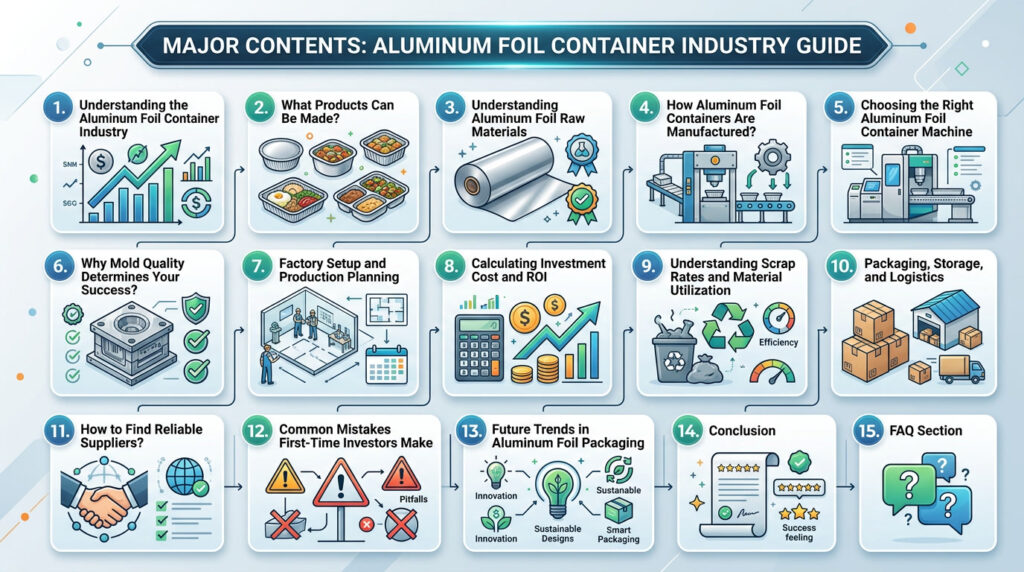
1. Understanding the Aluminum Foil Container Industry
Before investing a single dollar, you need to see the full picture. The global aluminum foil container market has been expanding steadily, driven by three main forces: the rise of food delivery apps, increasing consumer preference for recyclable packaging, and the growing popularity of ready-to-eat meals that go straight from freezer to oven.
Major Importing Regions
From our experience helping factories export worldwide, these are the most active markets:
United States: The largest importer. High demand for takeout containers, BBQ trays, and catering sizes.
India: Rapidly growing domestic food delivery market. Price-sensitive but volume-driven.
Middle East (UAE, Saudi Arabia, Kuwait): Strong demand for large family-size trays and airline catering containers.
Africa (Nigeria, Kenya, Ghana): Emerging market. Many first-time buyers looking for complete production lines.
Europe: Strict quality standards but premium prices. High interest in smooth-wall containers and sustainable packaging.
For specific import data and country rankings, see:
Growth Trends That Matter to You
Food delivery growth means more single-use containers.
Plastic bans are pushing restaurants and food trucks toward aluminum.
Recyclability is no longer a nice-to-have. Big brands require it.
If you are planning an aluminum foil container business, target a mix of local food distributors and export buyers. That diversifies your risk and keeps production running.
Related Reading:
2. What Products Can Be Made from Aluminum Foil?
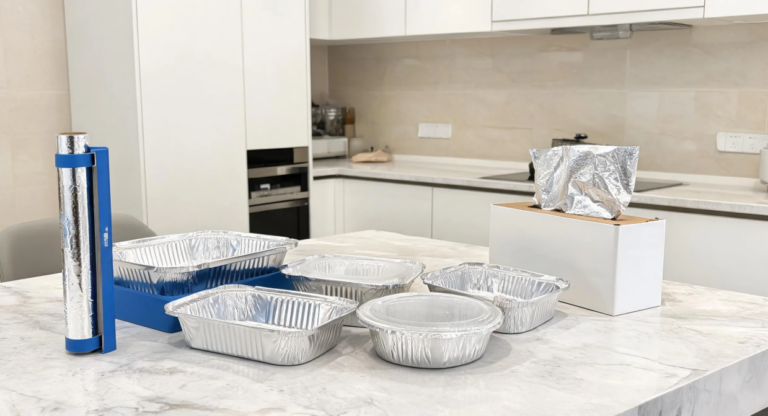
One question we hear constantly: “Can my machine make different products?” The answer is yes, but mostly with a limited height of 100mm for foil containers.
A standard foil container production line can produce dozens of shapes and sizes. Here are the major categories:
Rectangular Containers
The most common. Used for takeaway meals, lasagna, casseroles, and catering. Sizes range from india 120 containers to US full size pan.
Round Containers
Popular for pies, cakes, side dishes, and soups (with lids). Most popular round size is 6″,7″,8″,9″ foil container.
Multi-Compartment Containers
Growing fast. These have two or three sections for meals with separate sides. More complex molds, but higher profit margins.
Airline Containers
Compact, lightweight, and stackable. Airlines are replacing plastic with aluminum for in-flight meals. Volume is high, but quality requirements are strict.
Smooth Wall Containers
The premium segment. No visible ribs. Looks almost like stamped metal. Requires better raw material quality and precise molds.
Aluminum Foil Lids
Often overlooked, but lids are a consistent revenue stream. Foil lids, paper lids, and clear plastic lids can all be produced or sourced.
Aluminum Foil Sheets
Widely used for wrapping, cooking, baking, grilling, and food storage in homes, restaurants, and catering services. Available in different sizes and thicknesses.
Household Foil Products
Beyond food containers, you can produce foil rolls, sheets, and baking pans.
For a complete product list with images and applications, read:
3. Understanding Aluminum Foil Raw Materials
You cannot make good containers from bad foil. This is where many new factory owners try to save money, and it backfires.
Alloy Types
The aluminum foil raw material you choose directly affects product strength, forming quality, and scrap rate.
3003 Alloy: Higher strength. Good for most containers,More expensive.
8011 Alloy: Most common for large containers like US full size pan,fish plates. Good balance of strength and formability.
8006 Alloy: high strength, good elongation, and excellent surface quality, performing particularly well in high-end food packaging.
Temper Types
Temper refers to how hard or soft the foil is.
H24 (Half-hard): Most common for food containers. Holds shape well but still formable.
H22: Slightly softer. Good for shallow trays and lids.
O (Soft annealed): Fully soft. Used for household foil rolls and sheet.
From what we’ve seen in many foil container factories, beginners should start with 3003 H24 for small containers and 8011 H22 for large containers.
What About Price?
The reasonable price for aluminum foil raw material fluctuates with global aluminum markets. But beyond the base price, consider:
Width: choose the exact width for the mould to produce the containers.
Thickness: Thinner foil (0.030–0.050mm) for small containers, thicker (0.07–0.1mm) for large trays.
Surface quality: Oil spots, holes, or uneven thickness will increase your scrap rate significantly.
Related reading:
4. How Aluminum Foil Containers Are Manufactured?
The production process is simpler than you might think. Understanding each step helps you troubleshoot problems later.
Step 1: Raw Material Loading
The aluminum foil jumbo roll is mounted on an feeder. Proper alignment is critical to prevent wrinkles.
Step 2: Feeding and Lubrication
The foil feeds through a series of rollers. Pre-lubricated foil is available, but many factories add a light oil to reduce friction during forming.
Step 3: Punching and Stamping
The press comes down, and the mold punches the flat foil into shape. This happens in milliseconds.
Step 4: Forming
The foil is stretched into the container shape. The mold’s design determines how smoothly the material flows.
Step 5: Curling and Rim Forming
The edges are curled or hemmed to create a strong, safe rim. No sharp edges.
Step 6: Stacking and Counting
Finished containers are stacked automatically. Most modern lines count and stack without manual intervention.
Step 7: Packaging
Stacks are wrapped, boxed, or bagged depending on customer requirements.
Step 8: Cartoning and Shipping
Finished boxes are palletized and prepared for shipment.
A fully automatic foil container production line can run 40–50 strokes per minute, producing thousands of containers per hour. Semi-automatic lines run slower but cost less upfront.
For more information,read
5. Choosing the Right Aluminum Foil Container Machine
The machine is the heart of your factory. Choose poorly, and you will fight production problems every day. Choose well, and everything else becomes easier.
C-Frame (Open Back) Presses
Lower cost. Suitable for smaller containers and lower volumes.
Good for beginners testing the market.
Limitations on container depth and width.
H-Frame (Straight Side) Presses
Higher cost, but much more rigid.
Better for deep-draw containers, large trays, and high-speed production.
Recommended for large capacity production.
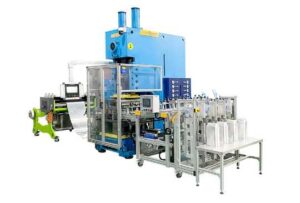
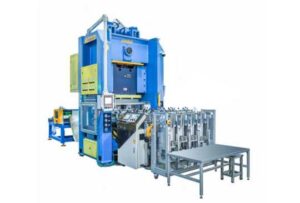
From our experience, if you plan to run more than one shift or produce containers deeper than 80mm, invest in an H-frame press. The extra cost pays back in lower scrap rates and fewer machine breakdowns.
Key Specifications to Check
Tonnage: How much force the press delivers. 45-63 tons for small containers, 80–130 tons for large and deep containers.
Stroke length: Determines maximum container depth.
Speed (SPM): Strokes per minute. Higher speed means more output, but mold quality must keep up.
Feeding system: Servo-driven feeders are more precise than mechanical type.
Lubrication system: Automatic lubrication saves labor and reduces wear.
New or Used?
Used machines are available, but be very careful. Foil container presses run continuously. A used machine may have worn bearings, cracked frames, or outdated controls. Unless you have an experienced technician, buy new from a reputable supplier. The warranty and support are worth the extra cost.
If you want to know more details,you can see from below article.
6. Why Mold Quality Determines Your Success?
Here is a truth that takes most new factory owners years to learn: the machine matters, but the mold matters more.
A perfect machine with a bad mold will produce scrap all day. A basic machine with an excellent mold can produce good containers consistently.
What Makes a Good Mold?
Material: High-quality tool steel, not cheap mild steel.
Precision: CNC-machined with tight tolerances. Hand-finished surfaces.
Heat treatment: Proper hardening reduces wear and extends lifespan.
Design: Progressive drawing stages, proper radii, and venting.
Mold Lifespan
A well-made aluminum foil container mold running on a good press with proper lubrication can produce millions of containers before requiring refurbishment. From real production data:
Good mold: around 30 million cycles above before major wear.
Average mold: 10 million cycles.
Poor mold: May fail within 500,000 cycles or less.
Related reading:
Scrap Rate and Molds
The mold directly determines your foil container scrap rate. Poorly designed molds cause tearing, wrinkling, and uneven rims. Even a 5% higher scrap rate eats directly into your profit margin. On a production line running 5 tons of aluminum per month, that 5% scrap difference could cost you thousands of dollars annually.
7. Factory Setup and Production Planning
Your factory layout matters more than you think. A well-organized workshop reduces waste, improves safety, and increases output.
Workshop Size Requirements
For a small aluminum foil container business with one automatic production line:
Minimum space: 150–200 square meters (1,600–2,150 sq ft)
Preferred space: 250–300 square meters
This includes room for:
Machine production line and material feeding area around 40m².
Finished container stacking and packing around 20m².
Raw material storage (foil rolls) around 35m².
Finished goods storage around 65m².
Office and break area around 20m².
Power Requirements
A typical foil container machine with auxiliary equipment requires:
One production line: 19.5–26 kW depending on press tonnage
Air compressor: 5.5–11 kW
Total: Approximately 25–37 kW
Ensure your factory has three-phase power. Single-phase is not sufficient.
The Critical Role of Air Compressors
Many beginners forget the air compressor. The press may be electric, but the stacker, ejector, and sometimes the feeder run on compressed air. An undersized or poor-quality air compressor will cause production stops.
Recommendation: Buy a screw-type air compressor (not piston type) with at least 50–100 liters of tank capacity. Add a dryer if you live in a humid climate. Water in the air lines will rust your mold and ruin containers.
For more information you can check
One-Stop Production Line
When planning a new factory, consider a one-stop solution. This means one supplier provides:
The full automatic production line
Molds
Installation and training
Why does this matter? Because when something breaks, you make one phone call. If you buy from different suppliers, each will blame the others. From years of experience, factories that buy complete lines from one reliable supplier start production faster and have fewer downtime issues.
Related Reading:
8. Calculating Investment Cost and ROI
Let us talk numbers. Every investor asks: “What is the aluminum foil container investment cost, and how long until I see returns?”
Major Cost Categories
| Cost Item | Estimated Range (USD) |
|---|---|
| One automatic production line (press + stacker) | $40,000 – $60,000 |
| Molds (first set of 3 sizes) | $25,000 – $30,000 |
| Air compressor and drying system | $2,000 – $5,000 |
| Raw material (first MOQ 3 tons of foil) | $12,000 – $15,000 |
| Packaging materials (boxes, bags) | $2,000 – $5,000 |
| Installation, training, shipping | $3,000 – $8,000 |
| Factory rent deposit and setup | $5,000 – $15,000 |
| Total estimated startup | $89,000 – $138,000 |
These are realistic figures. Some suppliers advertise lower prices, but always verify what is included on the price.
Revenue and Profitability
A single automatic line running 8 hours per day can produce approximately:
- India 450 4 cavities: 12,000 pieces per hour
- India 750 3 cavities: 9,000 pieces per hour
Example ROI calculation (conservative estimate on 450 2.5g 4 cavities 14% Scrap rate):
1 ton production: 343445 pcs
Raw material cost: 3,800usd
Labor, utilities, rent: $1,000 – $2,000 per month
Check your local selling price in your area, you can calculate the approximate ROI.Many factories achieve faster ROI by running two shifts or targeting premium products.
Related reading:
9. Understanding Scrap Rates and Material Utilization
If you ignore scrap rate, you leave money on the floor,Literally.
What Determines Scrap Rate?
From actual production monitoring, the main factors are:
Product shape and complexity: Deep containers with sharp corners have higher scrap rates.
Product size: Larger containers waste more material from the web between parts.
Rim design: Hemmed rims require more precise forming.
Number of cavities: Single-cavity molds are simpler but slower. Multi-cavity molds (2, 4, or 6 containers per stroke) are faster but more sensitive to material variations.
What Is a Good Scrap Rate?
Square: 8–15% scrap
Round and abnormal shape: 15–19% scrap
A difference of 5% scrap on a line using 100 tons of aluminum per year means 5 tons of waste. At $4,000 per ton, that is $20,000 lost. And you still pay to recycle the scrap (though you do get some money back).
Reducing Scrap Rate
Start with high-quality molds
Use consistent raw material (same alloy, same temper, same supplier)
Maintain proper lubrication
Train operators to stop the machine when they see defects
Related Reading:
The Secondary Income from Waste Aluminum
Scrap is unavoidable, but it is not worthless. Clean aluminum scrap can be sold to recyclers. Some factories install small baling presses to compact scrap foil into dense bales, which fetch higher prices.
Related Reading:
10. Packaging, Storage, and Logistics
Production is only half the battle. Your containers need to reach customers in perfect condition.
Lid Options
Most containers are sold with lids. You have three main choices:
Plastic lids: Clear, snap-on lids. Popular for cold food and fresh produce. You would source these from a plastic injection molding supplier.
Foil lids: Rolled foil with a curled edge. Can be produced on your existing line with a different mold.
Paper lids: Eco-friendly option. Often used for dry products or as dust covers.
You can check:
Storing Aluminum Foil Raw Material
Improper storage ruins aluminum foil. Moisture, temperature changes, and dust all cause problems.
Common storage mistakes:
Storing rolls directly on concrete floors (draws moisture)
Leaving rolls unwrapped in humid conditions
Stacking rolls too high (causes deformation)
Best practices:
Keep foil rolls in original packaging until use
Store in a dry, climate-controlled area (15–25°C, humidity below 60%)
Use wooden pallets or racks to keep rolls off the floor
Rotate stock: first in, first out
Related Reading:
Calculating Container Loading Capacity
If you export, knowing how to load containers efficiently saves significant shipping costs.
A standard 40-foot container holds approximately:
2,000–2,500 cartons of small foil containers
Or 1,000–1,500 cartons of large trays
But the exact number depends on:
Carton dimensions (nesting containers reduces volume)
Palletization
Stacking height limits
Related Reading:
Shipping Heavy Machinery
When your production line ships from the supplier, understand:
Machinery is typically shipped in export wooden crates
You need a forklift or crane for unloading
Some suppliers include door-to-door shipping; others quote FOB (Free on Board) only
Related Reading:
11. How to Find Reliable Suppliers?
This is where many first-time buyers make expensive mistakes.
The Risk of Trading Companies
On Alibaba and other B2B platforms, many sellers are trading companies, not actual manufacturers. They buy from factories and add 30–50% markup. Worse, they often lack technical knowledge. When your machine breaks, the trading company cannot help.
How to Identify Real Manufacturers?
Ask for factory address and request a video call
Check if they specialize in foil container equipment (not “all kinds of machinery”)
Ask about spare parts availability
Request customer references in your region
Why Work with a Sourcing Agent?
A good sourcing agent who speaks Chinese and understands the aluminum foil container industry can:
Verify real factory credentials
Negotiate better prices
Handle quality inspections before shipping
Coordinate shipping and customs clearance
Provide ongoing support for spare parts
From our experience, the 5–10% fee an agent charges is easily recovered through lower machine prices, fewer problems, and faster startup.
Related Reading:
12. Common Mistakes First-Time Investors Make
After working with dozens of new factory owners, we see the same mistakes repeated.
Mistake 1: Buying Machines Only by Price
The cheapest machine is rarely the best value. A $25,000 machine that breaks down monthly costs more in lost production than a $40,000 reliable machine.
Mistake 2: Ignoring Mold Quality
As discussed earlier, bad molds ruin everything. Always invest in good molds, even if it means spending less on the machine.
Mistake 3: No ROI Planning
Many investors cannot answer: “How many containers do you need to sell to break even?” Do the math before spending money.
Mistake 4: Inadequate Market Research
Assuming customers will appear is dangerous. Talk to local food packaging distributors, restaurants, and supermarkets before ordering equipment. Confirm demand.
Mistake 5: Forgetting Operating Costs
The machine price is just the beginning. Raw material, labor, electricity, rent, shipping, packaging, and maintenance add up quickly.
Mistake 6: No Spare Parts or Local Technician
When your machine stops, waiting 30 days for a part from China means 30 days of zero production. Keep critical spares on hand.
Related Reading:
13. Future Trends in Aluminum Foil Packaging
What comes next? If you are planning a long-term aluminum foil container business, pay attention to these trends.
Sustainability and Recyclability
Big brands are moving away from plastic. Aluminum is infinitely recyclable. Factories that can demonstrate recycled content or work with certified aluminum sources will win premium contracts.
Food Delivery Growth
The global online food delivery market is projected to grow another 10–15% annually. More deliveries mean more containers.
Smooth Wall Containers
Wrinkle containers are standard, but smooth-wall containers look more premium. They require better molds and higher-quality foil, but sell at higher prices.
Emerging Markets
Africa, Southeast Asia, and South America are still underserved. First-movers in these regions can capture significant market share.
14. Conclusion
Starting an aluminum foil container business is not easy, but it is absolutely achievable with the right planning. The demand is real, the technology is proven, and the margins can be very attractive.
But here is the most important thing we have learned from years in this industry: careful planning and a clear understanding of the entire production process are often more important than simply purchasing equipment. A cheap machine with a good mold, proper raw materials, and a well-organized factory will outperform an expensive machine with bad planning every time.
Focus on these five things:
Raw material quality – Do not cut corners.
Mold quality – This is non-negotiable.
Reliable machinery – H-frame, automatic, from a real manufacturer.
Market research – Know who will buy before you produce.
After-sales support – Spare parts, training, and service matter.
If you get these right, your aluminum foil container manufacturing business can grow from a single line to multiple lines, from local supply to export markets.
The opportunity is there. Plan carefully, execute step by step, and you can build a profitable, sustainable business in the aluminum foil packaging industry.
15. FAQ Section
General Business Questions
Q1: How much does it cost to start an aluminum foil container business?
A realistic startup budget for one automatic production line, including machine, molds, raw material, and factory setup, ranges from $60,000 to $130,000 USD. Smaller semi-automatic lines can be less, but production capacity is much lower.
Q2: Is an aluminum foil container business profitable?
Yes, with proper planning. Typical net profit margins range from 25–40%, depending on raw material costs and selling prices. Many factories recover their initial investment within 12–18 months.
Q3: Can I run a foil container factory without experience?
Yes, but you need proper training from your machinery supplier. Many first-time buyers succeed by starting with a one-stop solution that includes installation and operator training. Avoid learning entirely by trial and error.
Q4: What is the best aluminum alloy for food containers?
3003 H24 is the most common and recommended for beginners. It offers good formability and strength at a reasonable price.
Q5: How long does an aluminum foil container mold last?
A high-quality mold made from proper tool steel can produce around 30 million containers before needing refurbishment. Lower-quality molds may fail within 500,000 cycles.
Machinery Questions
Q6: What is the price of an aluminum foil container machine?
A fully automatic production line (press, feeder, stacker) ranges from $45,000 to $60,000 USD. This excludes molds, air compressor, forklift, and shipping. Always ask for a complete price list.
Q7: What is the difference between C-frame and H-frame presses?
C-frame (open back) presses are cheaper but less rigid, suitable for smaller containers. H-frame (straight side) presses are more expensive but much more stable, better for deep-draw containers and high-speed production. Serious manufacturers choose H-frame.
Q8: How much electricity does a foil container machine use?
A typical automatic line consumes 16.5–26 kW depending on press tonnage and ancillaries. You will need three-phase power. Single-phase is insufficient.
Q9: Do I need an air compressor?
Yes. The stacker, ejector, and some feeders run on compressed air. A screw-type compressor with a dryer is recommended, especially in humid climates.
Q10: How many containers can one machine produce per hour?
Output depends on container mold cavities and machine speed. A typical automatic line runs 40–50 strokes per minute. With 4 cavity molds, production can reach around 12000 containers per hour.
Production Questions
Q11: What is a normal scrap rate for foil container production?
The square foil scrap is 8%~15%.the round foil scrap is 15%~19%.
Q12: Can I use pre-lubricated foil to save cost?
Pre-lubricated foil is available but often more expensive than adding lubrication during production. For most factories, buying lubrication oil is more economical.
Q13: How do I reduce foil width waste?
Work with your mold designer to optimize the nesting pattern. Multi-cavity molds and proper web spacing reduce waste.
Q14: What are common production problems?
Wrinkling, tearing, uneven rims, and inconsistent stacking. Most problems trace back to mold condition, raw material quality, or machine operate issues.
Q15: How do I maintain my foil container machine?
Daily: Clean the mold and check the screw. Weekly:discharge exhaust gas and waste oil. Monthly: Check press alignment and oil levels. Keep spare parts on hand for common wear items.
Sourcing and Logistics Questions
Q16: How do I find a reliable machinery supplier?
Verify factory addresses, request video calls, ask for customer references, and consider using a sourcing agent who speaks the local language. Avoid trading companies that cannot answer technical questions.
Q17: Do I need a sourcing agent?
For first-time buyers sourcing from China, an agent is highly recommended. They verify factories, negotiate prices, inspect quality before shipping, and handle logistics. The fee is typically 5–10% of the machine cost.
Q18: How long does shipping take for heavy machinery?
Sea freight from China to most destinations takes 25–45 days. Add 2–4 weeks for production if the machine is not in stock. Door-to-door delivery with customs clearance can take 60–90 days total.
Q19: What spare parts should I order with my first machine?
Order extra die parts, bearings, sensors, and lubrication oil. Ask your supplier for a recommended spare parts list specific to your machine model.
Q20: Can I export containers to other countries?
Yes. Many foil container factories export. You will need to understand container loading (20ft or 40ft), shipping documentation, and import regulations in your target country. Start with local or regional distribution before expanding to export.
Share:
Get In touch
+86 15800939139
available from 10:00 – 19:00
Email: lumine@lumsourcing.com