
So you’re thinking about buying a foil container making machine. Maybe you’ve seen how fast takeout food, meal prep, and bakery sales are growing.Aluminum foil containers are everywhere – pie plates, lasagna trays, small portion cups. Demand looks good.
But machines aren’t cheap. A new automatic foil container production line can run 50,000usd-75,000usd,Before you write a check, you need one clear answer: What’s my ROI?
Return on investment tells you how many months (or years) it takes to earn back what you spent. In this post, I’ll walk you through a simple, numbers‑first method. You’ll learn how to do a proper Foil Container Plant Cost Estimation, avoid hidden traps, and calculate a realistic payback period. Let’s start with the basics.
What does ROI mean for a foil container line?
ROI is the percentage of your investment that comes back as net profit each year. The formula is simple:
ROI = (Net Annual Profit ÷ Total Investment) × 100
For example: You invest 50,000,and make15,000 net profit per year. Your ROI is 30%. That’s solid. But you also need the payback period – how long to recover the 50,000,That’s total investment divided by annualnet profit:50,000 ÷ $15,000 = 3.3 years.
In the foil container business, a 12‑ to 18‑month payback is common for well‑chosen lines. Anything over 30 months gets risky because molds wear out and competition can push prices down.
Step 1 – Calculate Raw Material Cost
Raw material is usually the largest cost in foil container production,thel prices fluctuate,investors should always use current market prices when calculating ROI.
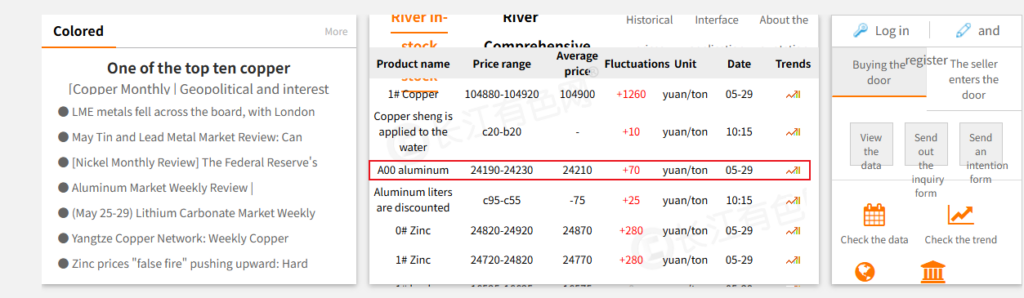
Based on the price of aluminum ingots on the China Metals website to calculate the raw materials, the price generally not be lower than the cost price. When the supplier offers a price lower than the ingots cost price to you, you should be cautious and beware of being cheated.
Now we can obtain an approximate price for one ton of aluminum coils by referring to the following prices.
- Aluminum ingot price is 24210RMB。
- Aluminum processing fee around 4800RMB per ton(Including the wooden boxes cost and profits),it depends on factors including the thickness of the aluminum foil, the presence of oil coating, and the service life of the processing equipment. Variations exist across different manufacturing facilities.
- FOB shipping cost:around 200RMB per ton,the prices vary depending on the loading port you choose.
- US dollars to Chinese Yuan exchange rate,now today’s exchange rate USD/RMB=1:6.8
Due to the fact that China will no longer offer export tax rebates on aluminum products starting from 2024, one ton aluminum jumbo roll will be:
(24210+4800+200)÷6.8=4295USD per on ton aluminum foil jumbo roll.
Step 2 – Calculate Production Output
Here I take an example with an Africa customer,who want to set up a production line for aluminum foil containers.
He wanna purchase T63 full automatic production line with 8389 3 cavities mould,to produce products with a thickness of 35 microns, he needs to consult the supplier about the single cavity area and the waste edge rate of 8389.
Now it is estimated that the single cavity area of the 8389 mold is 53,677.5 mm² and the waste edge rate is 13%.
Example setup:
- Machine speed: 50 pieces per minute (Most ideal production speed)
- Net speed after scrap and small stops: 45 pieces/min (about 10% loss)
- 3 cavities mold output per hour:3 × 45 × 60=8100pcs per hour
- Shifts: 2 shifts of 7.5 productive hours (allowing breaks and changeovers)
- Daily production: 8100pcs × 7.5 hours × 2 shifts = 121,500 pieces/day.
That’s a realistic number for a small workshop. If you only run one shift, cut it to 60,750pieces/day
Here you wanna do 8389 35micron as an example.
- product weight formula: 53,677.5mm² × 2.71(aluminum density)× 0.035mm/1000=5.09g
- product weight +aluminum scrap formula: {1+13/(100-13)}*5.09g =5.85g
If you want do 8389 container 35micron,product weight would be 5.09g, but you need 5.85g aluminum foil material for one piece.
- 1 ton raw material can make 1000000g➗5.85g≈170940pcs,given that one ton of raw materials costs 4295USD, we can calculate the unit price of each foil container. If you want to pack 1000 units in one carton box, then the cost of one carton box is 25.13USD(1000 units packed)
- Material Consumption per hour on T63:5.85g x 45pcs / min x 60 x 3/1000≈47.4kg
Base on 2 shift work schedule,you will consume 47.4 x 7.5 x 2=711kg per day,if you buy 3 ton raw material(MOQ),you can finish the production in just 4 days.
Step 3 – Calculate Paper Lid Cost
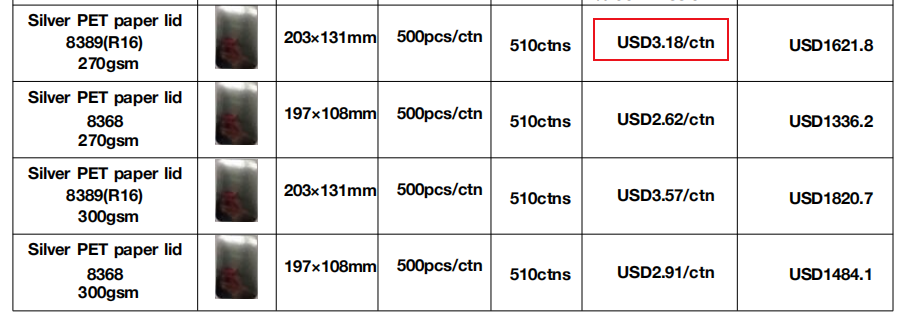
Many foil contianers packed with cardboard lid to sell.
Now we can calculate 1000 units cardboard price would be 6.36usd.
Step 4 – Calculate Carton Packaging Cost
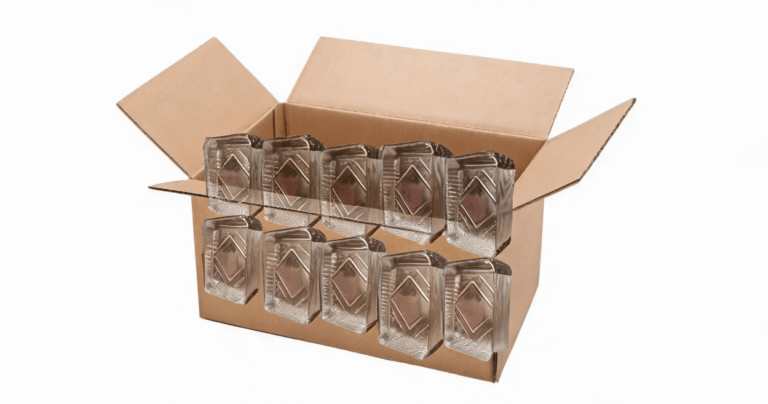
You need the supplier to provide the mould drawing so that we can calculate the size of the carton box.
The specific calculation method is as follows:
- carton length:product width × 5 bars+15mm space room
- carton width:product height+100 × Φ2(roll diameter)+10mm space room
- carton height:product length × 2 rows+15mm space room
Here I estimate the 8389 top out size is 210*136*42mm,So the carton packaging size would be 252mm × 695mm × 435mm,the estimated one unit price would be 0.88usd based on MOQ.
Step 5 – Consider Scrap Value Recovery
One advantage of foil container production is that scrap aluminum still has value.
Industry reference:
Scrap aluminum is often worth approximately 60% of new material value.
Explain:
Scrap recycling can significantly reduce actual material cost.
Many new investors ignore this factor.
Step 6 – Calculate Gross Profit Per Container
Create a simple example on 8389/1000pcs:
Costs include:
- raw material cost per conatainer:25.13USD
- paper cardboard lid:6.36USD
- carton packaging:0.88USD
Then compare:
Local market selling price
Show:
Selling Price – Production Cost = Gross Profit
Explain:
Each market has different selling prices.
Investors should use local wholesale prices.
What Matters More Than Machine Price?
Many buyers focus on machine quotations, but machine price is only one part of the investment.
In most foil container projects, ROI is influenced more by:
- Raw material cost – Aluminum foil is usually the largest production expense.
- Product selling price – Higher market prices can significantly improve profit margins.
- Production stability – Reliable machines reduce downtime and maintenance costs.
- Scrap rate – Better material utilization helps lower production costs.
- Market demand – Strong demand leads to faster sales and quicker investment recovery.
From what we’ve seen in many factory setups, controlling production costs and understanding local market demand often have a greater impact on profitability than choosing the cheapest machine.
Conclusion
A successful foil container project starts with accurate cost estimation. Before investing, it is important to understand:
- Raw material costs
- Packaging costs
- Scrap recovery value
- Local market selling prices
These factors have a direct impact on profitability and ROI.
For investors planning to enter the foil container industry,profitability depends on far more than equipment costs alone. If you’re evaluating this business opportunity, our The Complete Guide to Starting an Aluminum Foil Container Manufacturing Business provides a complete roadmap from startup planning to long-term profit optimization.