
Household aluminum foil and commercial aluminum foil may look similar at first glance. Both are made from aluminum and are used for food packaging, cooking, storage, and protection.
The main difference is not simply the aluminum itself. The real difference comes from how the foil is produced, converted, packaged, sold, and used.
Household foil is mainly designed for consumers and retail shelves. Commercial foil is generally made for restaurants, catering companies, bakeries, hotels, food processors, and other professional users. These different markets affect everything from jumbo roll specifications to rewinding, finished roll sizes, and packaging.
If you are planning to manufacture aluminum foil rolls, understanding this difference is important before choosing raw materials or investing in equipment.
What Is Household Aluminum Foil?
Household aluminum foil is aluminum foil designed for everyday consumer use. It is commonly sold in supermarkets, grocery stores, convenience stores, e-commerce platforms, and household product stores.
Typical applications include:
- Wrapping food
- Covering dishes
- Cooking and baking
- Food storage
- Freezing food
- Grilling and roasting
- Protecting food from light and moisture
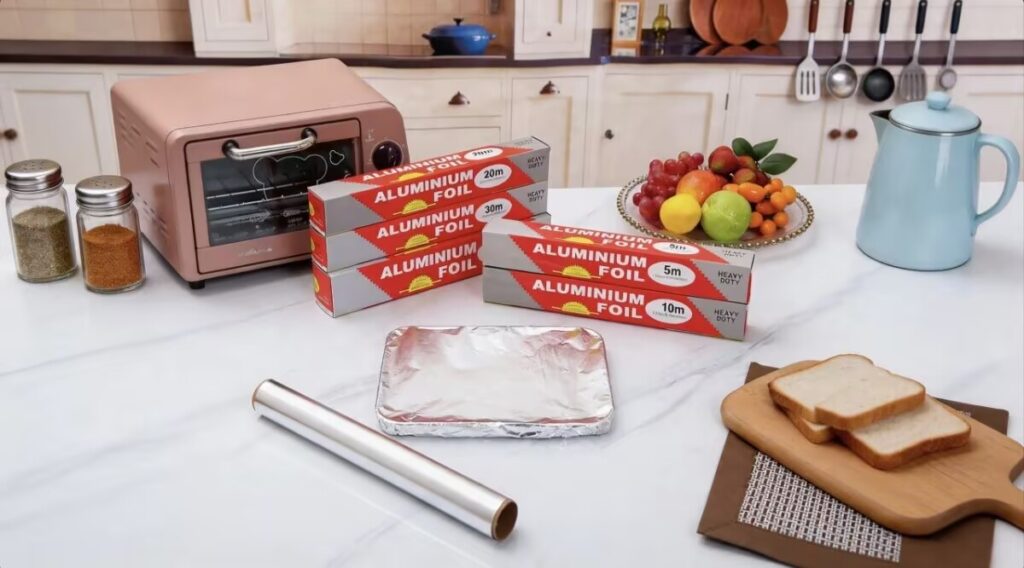
Household foil is usually supplied as relatively compact rolls. The roll is placed inside a paperboard box or other retail package, often with a built-in cutting edge.
For household products, the user experience matters. Consumers expect the foil to unwind smoothly, tear reasonably easily, and maintain a consistent thickness and appearance.
Packaging is also a major part of the product. A manufacturer selling to supermarkets may need attractive printed boxes, clear labeling, barcode information, and different packaging sizes for different markets.
What Is Commercial Aluminum Foil?
Commercial aluminum foil is generally intended for professional and high-volume users rather than individual households.
Typical users include:
- Restaurants
- Hotels
- Catering companies
- Bakeries
- Foodservice distributors
- Food processing businesses
- Takeaway food suppliers
- Wholesale customers
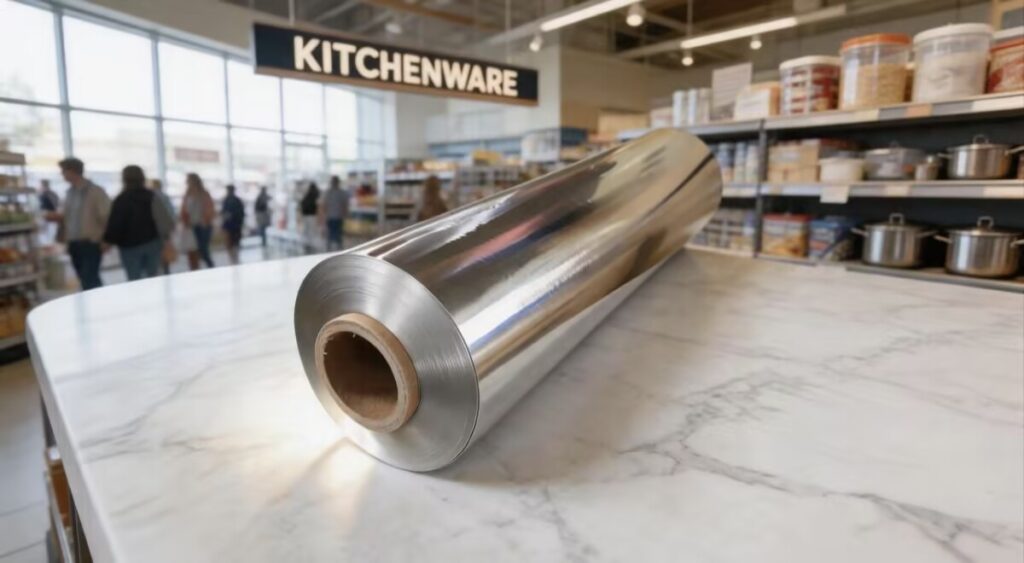
Commercial foil is often purchased in larger rolls or bulk cartons because professional users consume much more foil than an average household.
For these customers, productivity and cost per roll can be more important than retail appearance.
For example, a restaurant may prefer a large foil roll that lasts for several days instead of purchasing many small consumer rolls. A catering company may also prioritize roll length, consistency, and easy handling.
This changes the requirements for production and packaging.
Household Aluminum Foil vs. Commercial Foil: Key Differences
The following table gives a quick overview.
| Factor | Household Aluminum Foil | Commercial Aluminum Foil |
|---|---|---|
| Main users | Consumers | Restaurants, catering, foodservice and businesses |
| Main applications | Cooking, wrapping and food storage | Food preparation, catering and bulk foodservice |
| Roll size | Generally smaller | Generally larger |
| Packaging | Retail boxes and consumer packaging | Bulk cartons or professional packaging |
| Production focus | Appearance, convenience and consistency | Productivity, roll capacity and cost efficiency |
| Sales channels | Supermarkets, retail and e-commerce | Distributors, wholesalers and direct B2B sales |
| Branding | Usually important | Depends on customer and market |
| Purchasing priority | Convenience and retail presentation | Cost, capacity and performance |
| Production requirements | Flexible sizes and retail formats | Larger-volume and bulk formats |
These are general differences rather than fixed industry standards. Actual foil thickness, width, roll length, core diameter, alloy, and packaging specifications can vary depending on the target market and customer requirements.
Household Foil Usually Needs More Retail-Oriented Packaging
One of the biggest differences between household and commercial foil is packaging.
A household aluminum foil roll is often sold individually in a printed paperboard box. The packaging may include:
- Product name
- Foil thickness
- Roll length
- Product dimensions
- Brand information
- Usage instructions
- Barcode
- Manufacturing information
The package needs to look good on a retail shelf and provide enough information for consumers to make a purchasing decision.
Some manufacturers also use shrink wrapping or other secondary packaging to protect individual products during transportation.
Commercial foil is different.
A restaurant or catering supplier may care less about colorful retail packaging and more about:
- Number of rolls per carton
- Carton strength
- Roll size
- Shipping efficiency
- Storage requirements
- Easy handling
- Cost per roll
For B2B customers, packaging is often designed around transportation and warehouse efficiency.
Who Buys Household Aluminum Foil?
Household foil is mainly sold through consumer-oriented channels.
Typical buyers include:
Consumers
Individual households purchase foil for everyday cooking, baking, wrapping, and food storage.
Supermarkets and Grocery Stores
Retail chains usually require standardized products with appropriate labeling and packaging.
E-Commerce Sellers
Online sellers may offer different roll lengths, multi-packs, and private-label products.
Distributors
Household product distributors may purchase larger quantities and supply local retail stores.
Private-Label Brands
Private-label businesses can source foil from manufacturers and sell it under their own brand.
For manufacturers, private-label household foil can create opportunities to serve multiple customers using similar production equipment while changing the packaging and product specifications.
Who Buys Commercial Aluminum Foil?
Commercial foil is usually purchased by businesses that use aluminum foil regularly and in relatively large quantities.
Common users include:
Restaurants
Restaurants use foil for food preparation, cooking, storage, and takeaway orders.
Catering Companies
Catering businesses can consume large amounts of foil during events and food preparation.
Bakeries
Foil can be used for baking, food covering, preparation, and packaging applications.
Hotels
Hotels and large kitchens may purchase foil in bulk because of their daily foodservice requirements.
Food Processing Companies
Some food businesses use aluminum foil as part of their food preparation or packaging operations.
Foodservice Distributors
Distributors can purchase commercial foil in bulk and supply restaurants, hotels, catering companies, and other businesses.
This creates a different purchasing model from household foil. Instead of focusing mainly on retail appearance, commercial buyers often compare roll capacity, consistency, price, availability, and supply reliability.
Can the Same Machine Produce Household and Commercial Foil?
In many cases, the same basic rewinding equipment can be used for both household and commercial foil, but the machine configuration and tooling may need to match the finished product.
For example, the production requirements can change depending on:
- Foil thickness
- Core diameter
- Roll diameter
- Roll length
- Production speed
- Packaging format
A manufacturer producing several product sizes may therefore choose equipment with greater flexibility.
For household foil, a production line may include:
Jumbo roll →Rewinding → Roll cutting → Individual packaging → Cartoning
For commercial foil, the process may be simpler:
Jumbo roll → Rewinding → Large finished rolls → Bulk carton packing
The best setup depends on the products you plan to sell rather than simply choosing the most automated machine available.
Which Type of Aluminum Foil Is Better for Your Business?
There is no universal answer. The right choice depends on your customers and sales strategy.
If You Want to Target Supermarkets
Household foil is usually the more logical choice.
You will need to pay attention to:
- Retail packaging
- Brand design
- Roll dimensions
- Consumer-friendly formats
- Product appearance
- Packaging automation
Competition can be strong, so branding and distribution can matter almost as much as manufacturing cost.
If You Want to Supply Restaurants
Commercial foil may be more suitable.
Professional buyers are often more interested in larger rolls, reliable supply, and competitive pricing.
You may also have fewer packaging requirements compared with consumer retail products.
If You Want to Build a Private-Label Business
Household foil can be an attractive option because different customers can use different packaging designs while the underlying production process remains relatively similar.
However, you need to calculate the cost of printing, packaging, warehousing, and distribution before deciding.
If You Want to Become a Foodservice Distributor
Commercial foil may provide a better fit because your customers are likely to purchase repeatedly and in larger quantities.
In this case, logistics and inventory management become especially important.
Household vs. Commercial Foil: Which Market Should You Enter?
For a new aluminum foil business, the choice should start with the market rather than the machine.
If your goal is to build a consumer brand, household foil may provide more opportunities for retail packaging, private labeling, and e-commerce sales.
If you already have relationships with restaurants, catering companies, or foodservice distributors, commercial foil may be easier to sell because customers purchase based more on practical performance and supply conditions.
Some manufacturers choose to serve both markets. This can make better use of production equipment, but it also requires more product specifications, packaging formats, inventory, and sales management.
The key is to confirm the market first and then design the production line around it.
Conclusion
Household aluminum foil and commercial aluminum foil are made from the same basic material, but they serve different markets.
Household foil focuses more on consumer convenience, retail packaging, manageable roll sizes, and product presentation. Commercial foil focuses more on professional use, larger quantities, productivity, and cost efficiency.
For manufacturers, the difference affects much more than the finished roll. It can influence the choice of aluminum foil jumbo rolls, rewinding equipment, packaging machines, production capacity, and even the overall business model.
Before buying equipment, start by identifying your target customers and their required product specifications. Once those requirements are clear, it becomes much easier to select the right raw materials, machines, and packaging system for your aluminum foil production business.
FAQ Section
What is the difference between household and commercial aluminum foil?
Household aluminum foil is mainly designed for consumers and retail sales, while commercial foil is generally intended for restaurants, catering companies, foodservice businesses, and other professional users. The major differences are usually roll size, packaging, purchasing volume, and customer requirements rather than the basic material itself.
Is commercial aluminum foil thicker than household aluminum foil?
Not necessarily. Commercial foil can be supplied in a wide range of thicknesses depending on the application. Thickness should be selected according to the customer’s requirements rather than assuming that all commercial foil is thicker than household foil.
Can the same machine produce household and commercial aluminum foil?
In many cases, the same basic rewinding equipment can be used for both. However, machine configuration, roll width, core size, tension settings, and packaging equipment may need to change according to the finished product specifications.
What aluminum foil is commonly used for household rolls?
Household kitchen foil is generally produced from aluminum foil grades suitable for food-contact applications. The exact alloy and temper should be selected according to the required thickness, production process, and applicable market requirements.
What equipment is needed to produce household aluminum foil rolls?
A basic production setup can include a rewinding machine, air compressor, cartoning packaging equipmen.The exact configuration depends on the finished roll specifications and required production capacity.
Is household aluminum foil profitable to manufacture?
Profitability depends on raw material prices, finished product prices, production efficiency, labor, packaging costs, logistics, and sales volume. Before investing, manufacturers should calculate the complete cost per finished roll rather than looking only at the machine price.
How do I choose the right aluminum foil jumbo roll?
Start with the finished product requirements. Check the required thickness, width, alloy, temper, surface quality, roll diameter, core, and winding quality. The jumbo roll should be compatible with your rewinding equipment and the specifications required by your target customers.