Many first-time investors assume that buying an aluminum foil container production line is simply about purchasing a machine. Find a supplier, pay the invoice, install the equipment, and start production. It sounds straightforward.
In reality, building a successful foil container factory involves much more than a single piece of machinery. From what we’ve seen in dozens of factory setups across Asia, the Middle East, and Africa, investors who focus only on the main machine often face delays, quality problems, and unexpected costs. The difference between a smooth launch and a stressful one often comes down to one thing: a one-stop service approach.
This article explains why a complete production line solution—including equipment matching, mold selection, raw material sourcing, and technical support—is crucial for new factory owners. And why working with an experienced sourcing partner can save you more money than buying directly from multiple factories.
What Does a One-Stop Foil Container Production Line Service Include?
1. Core Machinery
Aluminum Foil Container Machine: The central press unit (typically ranging from 45-ton to 80-ton or 130-ton capacity, depending on production needs) that punches the containers.
Feeding System:An automated decoiler and feeder equipped with lubrication systems to smoothly unroll and pre-lubricate the aluminum foil before it enters the press.
Stacker System: An automated pneumatic or electronic stacker that catches, counts, and neatly stacks the finished containers, reducing manual labor costs and preventing product damage.
2. High-Precision Molds
Product Design: Customizing container dimensions, rim styles (full curl, vertical flange, hemmed edge), and compartment splits according to local market demands.
Mold Development:Multi-cavity or single-cavity molds engineered from high-grade alloy steel to maximize output per stroke.
Testing and Fine-Tuning: Running trial production batches to check wall thickness, wrinkle distribution, and structural rigidity before final sign-off.
3. Raw Materials & Consumables
Aluminum Foil Coil Sourcing: Identifying the exact alloy grade (typically 3003 or 8011) and temper (usually H24 or O) required for smooth forming.
Material Specification Matching: Determining the correct foil thickness (micron rating) and width to prevent tearing inside the mold while minimizing scrap rates.
4. Auxiliary Equipment
Air Compressor: Providing steady, high-pressure, oil-free, and dry compressed air required for the pneumatic functions of the press and the air-blowing ejection systems of the molds.
Scrap Baler: Collecting and compressing the matrix scrap (the leftover foil lattice after containers are punched out) to optimize storage space and maximize scrap resale value.
Material Handling: Pallet jacks, forklifts, or specialized coil lifters to transport heavy aluminum rolls safely across the workshop floor.
Downstream Packaging Equipment:Automatic shrink-wrapping, boxing, and carton sealing systems to ready the finished goods for distribution.
5. Comprehensive Technical Support
Workshop Layout Design: Planning the physical placement of equipment to ensure an efficient workflow, optimal power routing, and proper ventilation.
Installation and Commissioning: Sending experienced technicians to install the machinery, align the molds and run operational tests.
Operator Training:Educating the local workforce on routine maintenance, safety protocols, mold changeover procedures, and basic troubleshooting.
In actual production, these individual elements cannot work in isolation. If your air compressor drops pressure by even a fraction of a bar, your automated stacker will misfeed, causing a backlog that halts your entire aluminum foil container production line. A one-stop service guarantees that all of these systems are engineered to speak the same mechanical language.
Why Production Planning Is More Important Than Machine Price
Many buyers focus obsessively on the machine quotation. They compare prices from ten suppliers and choose the cheapest. But the cheapest machine is not always the lowest-cost solution. Why? Because production planning determines your actual operating cost.
Successful factories are built on answers to these questions:
Which product sizes sell best in your market? (e.g., small containers, medium takeout containers, large trays etc.)
What foil thickness balances cost and strength? (typical range: 30–60 microns)
How many shifts will you run? (single shift or two shifts)
What is your acceptable scrap rate during the learning curve?
Who provides technical support when machine fails at 2 AM?
A one-stop service provider helps you answer these questions before you spend money. They have data from other factories in similar markets. They know that in some regions, 40-micron foil is standard; in others, 50-micron is required for hot food.
In contrast, when you buy only a machine, you get a machine. You are left to figure out the production plan alone. That is a heavy burden for a first-time factory owner.
The cheapest machine is not always the lowest-cost solution. Production planning and technical support often matter more.
How a Professional Sourcing Agent Creates Value?
A sourcing agent is not a factory representative. An independent sourcing partner works on your behalf. Their role is to protect your interests across the entire aluminum foil container production line procurement process.
Here is what a professional sourcing service typically provides:
Supplier Evaluation
Factory audits (real production floor, not just a showroom)
Capability assessment (maximum monthly output, quality certifications, export experience)
Financial health check (to avoid deposit loss)
Price Negotiation
Market price comparison across multiple regions (China, India, Turkey, etc.)
Know the exact bottom price in this industry and review of supplier quotations to identify inflated line items
Negotiation of payment terms (e.g., less deposite,part balance remains after installation etc.)
Quality Control
In-process production inspections
Pre-shipment testing of the complete line (mold sample containers, speed test)
Coordination of third-party inspections if desired
Project Management
Single point of contact for all suppliers
Scheduling to ensure all components arrive around the same time
Shipment consolidation to reduce freight costs
Risk Reduction
Avoiding unsuitable suppliers (e.g., those who outsource critical parts)
Reducing costly mistakes (wrong voltage, wrong mold size, missing auxiliary componets)
For a new investor, the sourcing agent acts as an experienced project manager who has already learned the hard lessons. That experience directly reduces your risk.
Why Many New Investors Choose a Sourcing Agent?
From what we’ve seen in many projects, first-time investors lack industry pricing knowledge and supplier reliability data. A sourcing agent brings three advantages:
Market intelligence – They know that a certain mold price is fair, while another is double the market rate. They know which machine brands have good aftersales records and which disappear after the warranty ends.
Negotiation leverage – An agent who regularly places orders for multiple clients gets better pricing than a first-time buyer. Suppliers value repeat relationships.
Objective comparison – A sourcing agent does not favor any single factory. Their incentive is to find the best solution for you. In contrast, when you ask a machine factory to source auxiliary equipment for you, they may prioritize their own profit margin or a partner factory’s commission.
This last point is critical. Some investors worry that a sourcing agent adds cost. But a good agent typically saves more money than they charge through better negotiation, reduced delays, and avoidance of wrong purchases.
Real Cost Comparison: Factory Recommendation vs. Independent Sourcing
Let us be transparent about how costs work.
When you ask a main machine factory to source additional equipment (e.g., an air compressor,forklift or other packing machine) from other suppliers, that factory usually adds a management fee,They are acting as a contractor. They will add more than 30% commission on the price.
Alternatively, an independent sourcing partner compares multiple suppliers for each component. They might find that the main machine factory’s recommended compressor is 30% higher than a different brand with identical specifications. They can also bundle shipping across suppliers to lower freight costs.
Here is a simplified example how much an experienced industry sourcing agent save the cost for you.
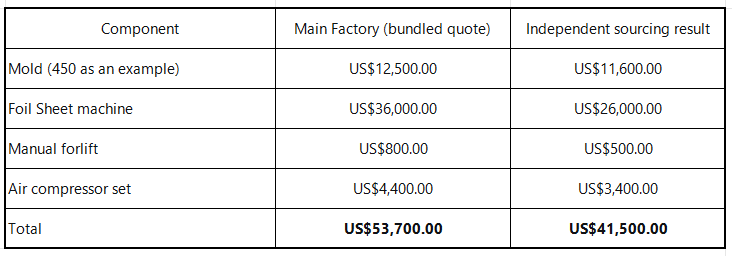
Plus the independent sourcing may include project management fees of $500–$2,000, bringing the total to $12,200,quite lower than the bundled factory quote, and you get dedicated oversight.
The point is not that one model is always cheaper. The point is that pricing transparency and supplier comparison create opportunities for cost optimization. An independent sourcing partner exists to find those opportunities.
For first-time factory owners, working with an experienced sourcing agent is often one of the most cost-effective decisions during the entire project.
Conclusion
A successful foil container factory requires more than a single machine. It requires proper planning, matched equipment, reliable suppliers, quality molds, stable raw materials, and responsive technical support. New investors who try to assemble these pieces themselves face high risks: compatibility problems, project delays, and hidden coordination costs.
A one-stop foil container production line solution—whether delivered directly by a turnkey supplier or coordinated by a professional sourcing agent—significantly reduces those risks. It shortens the learning curve, improves production efficiency, and gives you a single point of accountability.
If you are planning your first factory, a reliable one-stop partner can greatly reduce the risks of starting a new manufacturing business. Learn how sourcing, machinery, molds, raw materials, and technical support work together in our The Complete Guide to Starting an Aluminum Foil Container Manufacturing Business.
FAQ Section
1. What is a one-stop foil container production line service?
A one-stop service provides all necessary components for production—main machine, molds, feeding and stacking systems, auxiliary equipment (air compressor, scrap baler, forklift), raw material sourcing support, installation, and training. The provider coordinates everything so you deal with one contact instead of multiple suppliers.
2. What equipment is required for a foil container factory?
At minimum: an aluminum foil container machine, a set of molds, an automatic or semi-automatic stacker, an air compressor with dryer, and a forklift. Optional equipment includes an embossing device and packaging machinery. A turnkey solution includes all of these matched to your production plan.
3. Is buying directly from factories always cheaper?
Not necessarily. When you buy directly, you don’t know if the factory gave you their best price or a price based on how well you negotiate.Also, in the final stage, every supplier says their quality is good, but prices vary a lot. As a new buyer, you can’t tell if a higher price means real quality or just paying extra because you don’t know the market.
A sourcing agent knows what each supplier charges different customers. They review the price for you. That way, you get the best value—not a price based on your lack of experience.
4. How can a sourcing agent reduce factory setup costs?
By comparing multiple supplier quotes, negotiating better payment terms, identifying overpriced components, consolidating shipments to lower freight, and preventing expensive mistakes (e.g., buying the wrong mold size or foil thickness). The savings often exceed the agent’s fee.
5. What are the risks of managing multiple suppliers?
Risks include incompatible technical standards, warranty disputes (each supplier blames the other), inconsistent quality, communication breakdowns, and no single party responsible for the complete line’s performance. You become the integrator—a role that requires significant experience.
6. How do I choose a foil container production line supplier?
Look for demonstrated experience with complete lines (not just single machines), reference projects in your region, transparent specifications for all included components, and clear after-sales support terms. Alternatively, hire a machinery sourcing service to evaluate suppliers on your behalf.
7. Is a sourcing agent worth it for first-time investors?
Yes, in most cases. A good sourcing agent prevents costly mistakes that first-time buyers commonly make. They understand real market pricing, know which suppliers are reliable, and manage the entire project. The fee is usually a small fraction of the money saved through better decisions and faster startup.