
Aluminum foil is one of the most widely used materials in modern packaging and daily life. From wrapping food in the kitchen to producing aluminum foil containers, yogurt lids, and hairdressing foil, aluminum foil plays an important role in many industries.
Most people use aluminum foil every day, but few understand how it is made or why different types of aluminum foil are used for different applications.
In actual foil container production, selecting the right foil material is one of the most important factors affecting product quality, forming performance, and production stability.
In this guide, we will walk through what aluminum foil actually is, how it is made from ingot to finished roll, the common alloys and temper conditions you will encounter, and how to select the right material for specific packaging applications. Whether you are a foil container manufacturer, packaging buyer, or considering entering the business, this information will help you make better sourcing decisions.
What Is Aluminum Foil?
Aluminum foil is a thin sheet of aluminum metal produced by rolling large slabs through heavy rolling mills until the material reaches the desired thickness. Typically, household aluminum foil roll ranges from 0.009mm to 0.025mm thick—thin enough to tear easily but strong enough to hold food and withstand oven temperatures.
So why is aluminum foil so widely used? The answer comes down to several key properties:
- Excellent barrier properties. Aluminum foil is completely impermeable to light, oxygen, moisture, and bacteria. Once a package is sealed, what is inside stays fresh and protected.
- Heat resistance. Foil handles temperatures from freezing to over 200°C (400°F), making it suitable for both freezer storage and oven cooking.
- Lightweight structure. A roll of household foil weighs very little compared to alternative materials, which reduces shipping costs and environmental impact.
- Recyclability. Aluminum can be recycled indefinitely without losing its properties. Used foil can go back into production as new aluminum products.
Common applications you will see every day include food packaging, household foil rolls, takeaway foil containers, dairy packaging lids, and even hairdressing foil used in salons. Different applications require different foil properties—and that is where alloy selection becomes critical.
From what we have seen in the aluminum packaging industry, the most common mistake new buyers make is assuming all aluminum foil is the same. It is not. The alloy, temper, and thickness all affect how the material performs on your production equipment.
Understanding Aluminum Foil Alloys and Temper Conditions
Different applications require different material properties. A foil lid that heat-seals to a yogurt cup needs different characteristics than a heavy-duty container holding a frozen lasagna. This is why aluminum foil alloys and temper conditions exist.
Common Household Foil Alloys
3003 Aluminum Foil
This alloy contains a higher percentage of manganese compared to other common foil alloys. The manganese provides higher strength and good forming performance. We see 3003 used extensively for containers that need structural rigidity—things like large takeaway trays, round plates, and containers with complex shapes.
8011 Aluminum Foil
This is the most widely used household foil alloy globally. It contains iron and silicon as the primary alloying elements, which gives it excellent flexibility and good performance for food packaging applications. Most household foil rolls you buy at the grocery store are 8011. It is also commonly used for container production, though the temper condition differs between uses.
8006 Aluminum Foil
Less common but important for certain applications. This alloy is often used for higher-strength container applications, particularly when the finished container needs to hold heavier foods or withstand more handling during distribution.
Common Temper Conditions
Temper refers to how the foil is processed after rolling. Think of it as the material’s “personality”—how hard or soft it is, how much it will stretch, and how it behaves under pressure.
H24 Temper: Strain-hardened and partially annealed. This temper is harder and stronger. From what we have seen in aluminum foil container manufacturing, 3003/H24 is widely used for stamped foil containers.
H22 Temper: Similar to H24 but with slightly different hardness characteristics. Many foil container molds are designed specifically around 3003/H24 or 8011/H22 depending on the part geometry.8011/H22 is widely used for large pans such as full size pan,oval roast and fish plates etc..
O Temper: Fully annealed and soft. This is the most flexible condition. Household foil rolls are typically 8011-O because the material needs to wrap easily around food and fold without cracking.
General hardness comparison: H24 is harder than H22, which is harder than O temper.
Most foil container molds are designed around 3003/H24 and 8011/H22. Some large trays and compartment containers may use different materials depending on mold testing results. If you are setting up a new production line, always run trials with your specific alloy and temper before committing to large material orders.
Common Types of Aluminum Foil
The term “household aluminum foil” covers more products than you might expect. Here are the most common types you will encounter in packaging manufacturing.
1. Household Foil Rolls
This is what most people think of as regular aluminum foil—the rolls you find in kitchen drawers. Material is typically 8011-O temper. After the foil is manufactured, it is rewound onto small cardboard tubes and packaged for retail sale. Applications include food wrapping, food storage, cooking, and baking. Pop-up foil sheets, where the foil is pre-cut and dispensed from an interleaved box, are another variant of this same product.
2. Aluminum Foil for Container Production
This is where things get more technical. Foil containers, takeaway trays, airline food containers, and bakery trays are all stamped from aluminum foil on high-speed press foil cotainer production line. Common materials include 3003-H24, 8011-H24, and 8011-H22.
The difference matters. A shallow tart container might run perfectly on 8011-H22, while a deep compartment tray with sharp corners may need the extra strength of 3003-H24 to avoid tearing during forming. Material selection is one of the most important factors in product quality.
3. Heat Seal Aluminum Foil
Heat seal foil is a specialized product used for packaging applications where the foil needs to bond to another material. Typical thickness ranges from 0.025mm to 0.05mm, and the alloy is usually 8011-O. The foil undergoes additional processing including printing, coating, and lamination. Common applications include yogurt lids, milk packaging, and dairy product sealing. The heat seal coating activates under pressure and temperature, creating a hermetic seal that keeps products fresh.
4. Hair Foil
This is a niche but significant market. Hair salons use lightweight aluminum foil for coloring and highlighting services. The foil needs to be easy to fold, resistant to tearing when wet, and able to withstand heat from dryers. Specialized foil grades are produced specifically for beauty applications. The requirements are different from food packaging, so do not assume your standard container foil will work for hair applications.
5. Coated Aluminum Foil
Coated foil is used for premium packaging applications where appearance matters as much as functionality. A special mention here: smooth wall aluminum foil containers require coated materials. The coating allows the container to release food easily and provides a more attractive finish.
At present, most high-quality smooth wall foil materials are imported from Europe because mature local supply remains limited. If you are entering the smooth wall container market, factor this into your supply chain planning.
How Are Aluminum Alloy Numbers Classified?
The international four-digit aluminum alloy system can seem confusing at first, but it is actually quite logical. The first digit tells you the major alloying element group.
1xxx Series: Pure aluminum (99% or higher). Used for applications requiring high conductivity or corrosion resistance.
3xxx Series: Aluminum-manganese alloys. The manganese adds strength without sacrificing formability. The most common example in foil packaging is 3003.
8xxx Series: Aluminum alloys containing other alloying elements not covered by other series. For foil applications, 8011 and 8006 fall into this category. The “11” and “06” indicate specific variations within the series.
For practical purposes, you do not need to memorize all the numbers. Just remember that for household foil and container applications, you will almost always be working with 1xxx, 3xxx, or 8xxx series alloys.
Understanding Common Aluminum Foil Specifications
When you receive a material quote or specification sheet from a supplier, you will see several technical parameters. Here is what they actually mean for production.
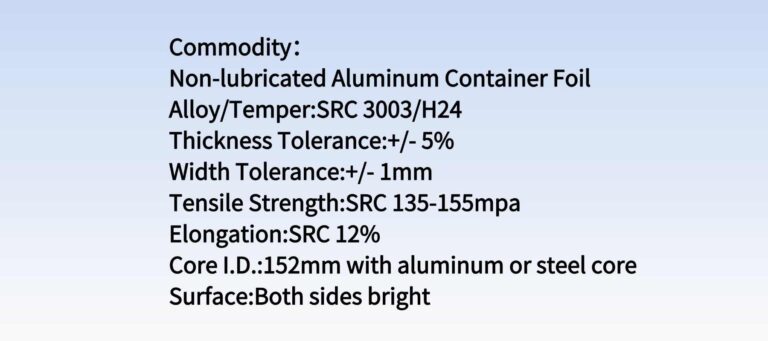
Let us use an example specification for non-lubricated aluminum foil:
- Alloy/Temper: 3003/H24
- Thickness Tolerance: This tells you how much the foil thickness can vary from the nominal value. Tighter tolerances mean more consistent forming on your presses. If your tolerance is too loose, some containers will tear while others wrinkle.
- Width Tolerance: Inconsistent width causes problems with foil feeding and stamping work.You have to consider this width tolerance to your minimum foil width on foil container raw material.
- Tensile Strength (135–155 MPa): This measures how much pulling force the foil can withstand before breaking. Higher tensile strength generally means stronger containers, but if the strength is too high, the foil may not form complex shapes properly.
- Elongation (12%): This tells you how much the foil can stretch before breaking. Higher elongation means the material is more formable. For deep containers, you want good elongation. For shallow trays, tensile strength matters more.
- Core Diameter (152mm): The inside diameter of the aluminum foil coil. This needs to match your decoiler or press feeder equipment.
- Bright Surface Finish: Some specifications call for both sides bright, meaning the foil has been double-rolled to create a shiny surface on both sides rather than one matte and one bright side.
Material selection directly affects product quality, production stability, and final application performance. We have seen manufacturers try to save money by switching to a cheaper alloy, only to end up with 20% scrap rates and unhappy customers. Start with the right material for your application, then test alternatives methodically if cost reduction is a priority.
Conclusion
Household aluminum foil is much more than a simple kitchen product. Through different alloys, temper conditions, and processing methods, aluminum foil can be transformed into a wide range of packaging products used in food packaging, dairy products, beauty applications, and aluminum foil container production.
Understanding the differences between materials such as 3003, 8011, and 8006 helps manufacturers and buyers select the right foil for their specific applications.
To deepen your understanding of how these specifications fit into the broader landscape of foil sourcing, quality evaluation, and cost management, read our complete Aluminum Foil Raw Material Guide for Packaging Manufacturers.
FAQ
What is household aluminum foil made of?
Household aluminum foil is made from aluminum combined with small amounts of alloying elements such as manganese, iron, and silicon.
What is the difference between 3003 and 8011 aluminum foil?
3003 generally offers higher strength, while 8011 provides better flexibility and is widely used for household foil products.
What does H24 mean in aluminum foil?
H24 is a temper condition that indicates the foil has been strain-hardened and partially annealed.
Why is annealing important?
Annealing stabilizes the material, reduces internal stress, and improves forming performance.
Which alloy is commonly used for foil containers?
3003/H24 and 8011/H22 are among the most common materials used for aluminum foil containers.
What is heat seal aluminum foil?
Heat seal foil is aluminum foil that has been coated or laminated for sealing dairy products, yogurt cups, and similar packaging.
What is hair foil used for?
Hair foil is used in salons for coloring and highlighting hair.
Why do smooth wall containers require special foil?
Smooth wall containers require higher-quality coated foil materials with excellent forming characteristics to achieve a wrinkle-free appearance.
Share:
Related Posts
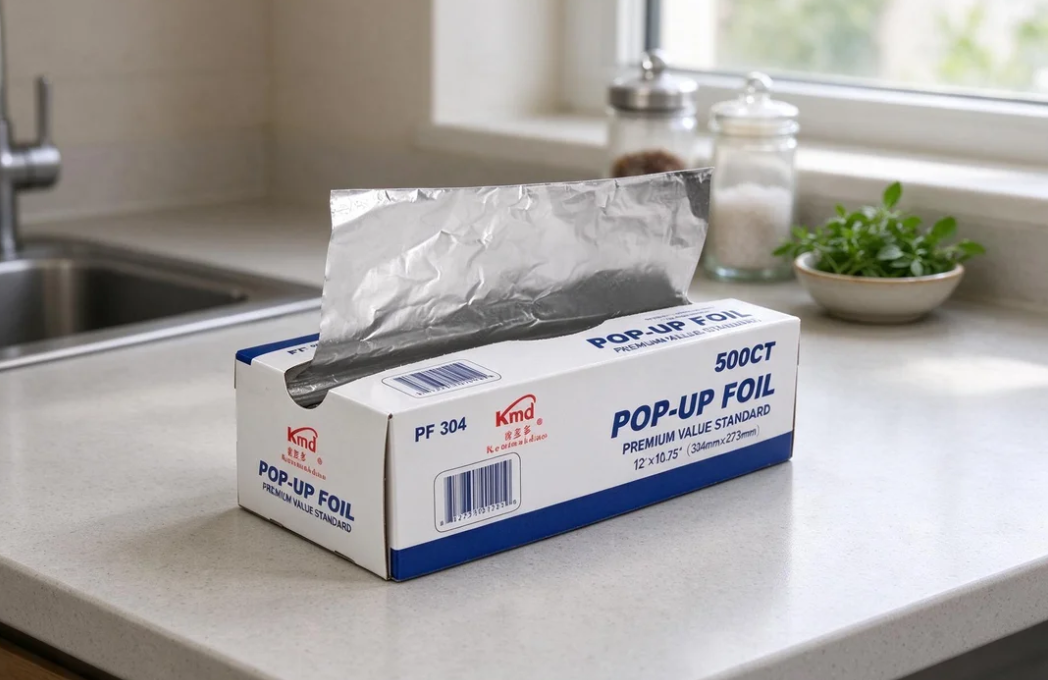
Common Specs of Interfolded Aluminum Foil Sheets: Length, Width, Folding Types & Pattern
Interfolded Aluminum foil sheets are widely used in food-service, household, catering, takeaway, and packaging applications where pre-cut and folded foil sheets offer a convenient alternative
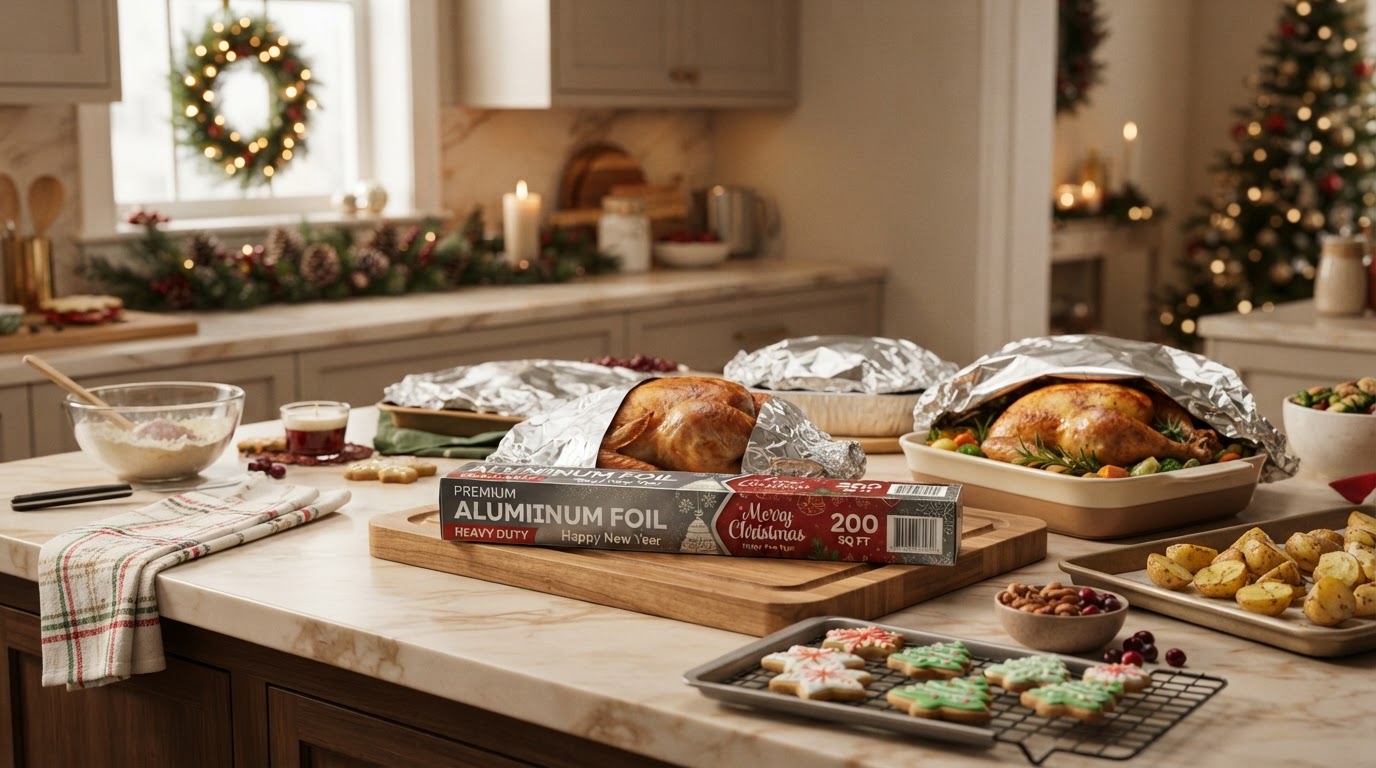
Aluminum Foil Sheet vs Foil Roll: Which One Is Right for Your Production
When sourcing aluminum foil, buyers often need to choose between aluminum foil sheets and aluminum foil rolls. Although both use aluminum foil as the basic
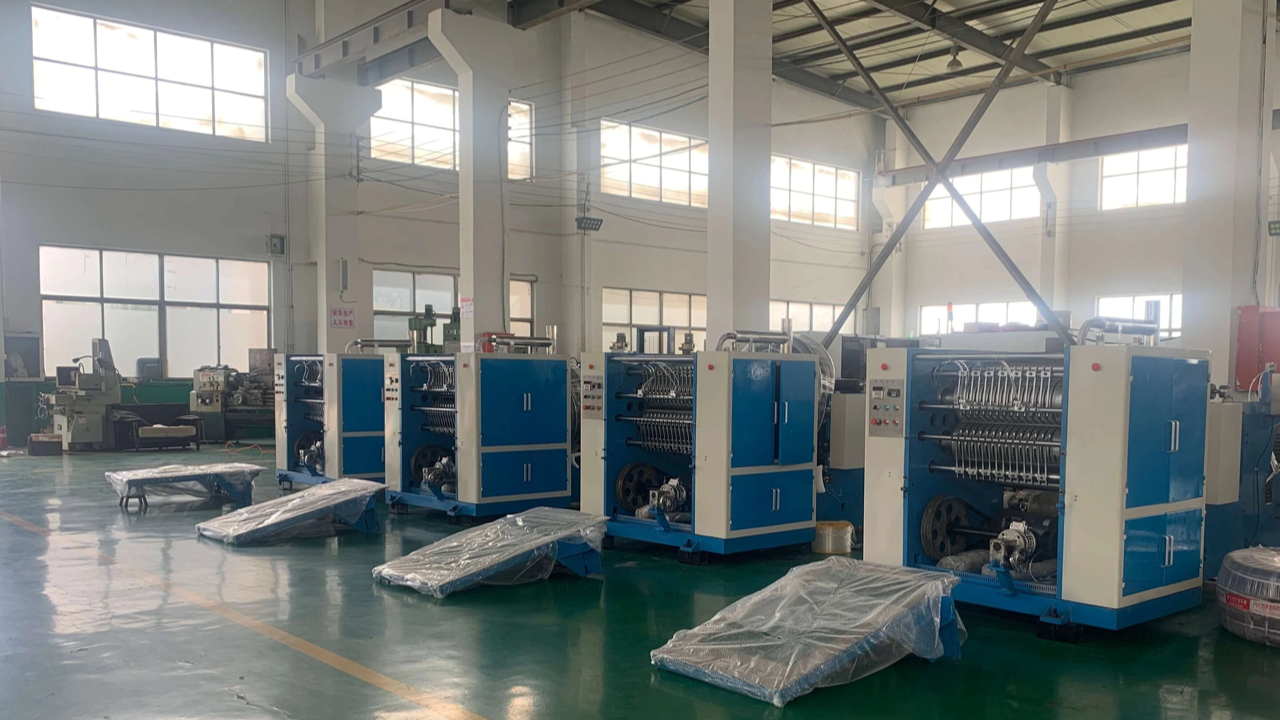
How to Make Aluminum Foil Interleaving Sheets – Machine and Production Guide
Starting an aluminum foil interleaving sheet production line can be a practical opportunity for manufacturers and distributors supplying foodservice, restaurants, bakeries, catering companies, and household

Household Aluminum Foil Seasonal Demand: BBQ, Thanksgiving & Holiday Trends
Household aluminum foil is a year-round product, but demand is not always the same throughout the year. Cooking habits, outdoor grilling, major holidays, retail promotions,
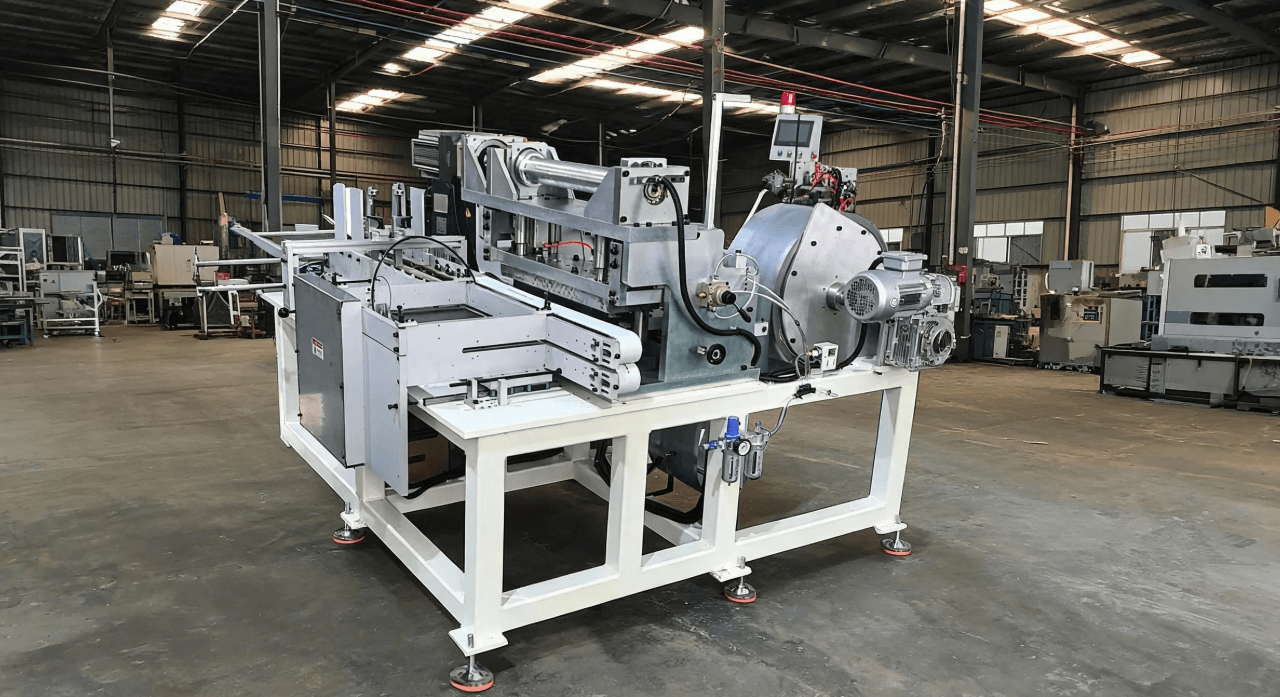
Tinplate Saw Blade Binding Machine: Complete Guide for Color Box Packaging
When you buy a box of household aluminum foil or cling film, you may notice a small metal cutting blade fixed to one edge of