
When you are setting up an aluminum foil container production line, the aluminum foil container mold is often the most significant investment after the machine itself. It is the “heart” of your production. Naturally, one of the first questions we hear is: “How long will this mold last before I have to buy a new one?”
In actual production, there isn’t a single “expiration date” stamped on a mold, a well-built mold can last a decade, while a poorly maintained one might start producing defective containers in less than six months.
Molds have many precision parts. Because they are modular, you can replace individual components rather than the entire unit. In 24/7 production, expect to replace high-wear parts like punch-die and cutting plate every 3 years, even though the main mold body remains functional.
In this guide, we’ll take a deep, practical look at the foil container mold lifespan, what causes them to wear out, and how you can ensure your die remains a high-performing asset for years to come.
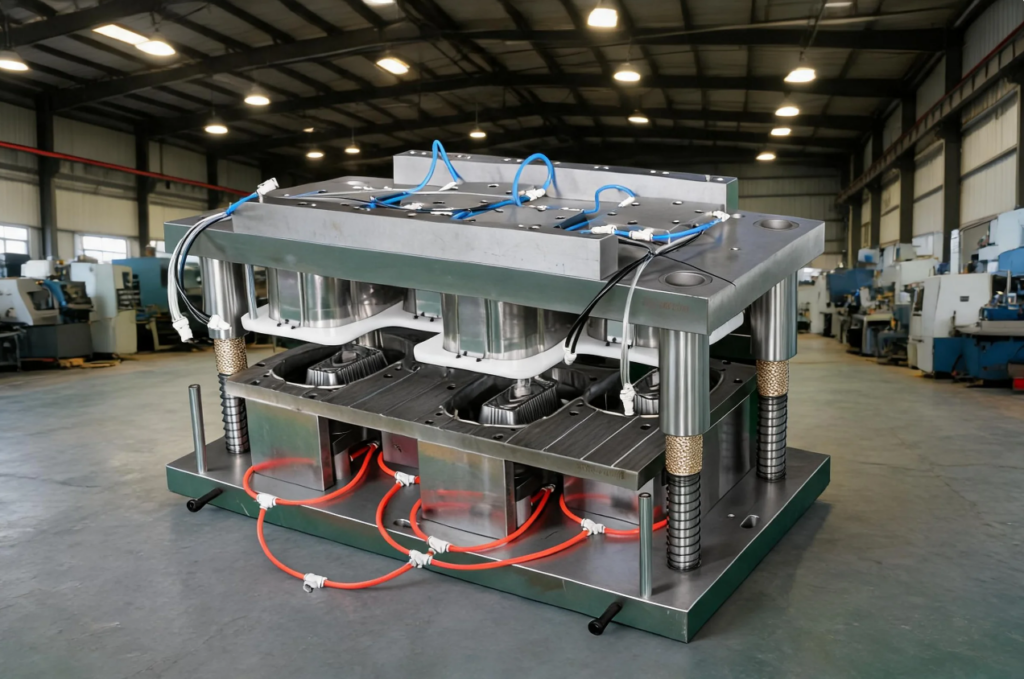
Key Factors That Determine Foil Container Mold Lifespan
1 Mold Material Selection
Aluminum foil might feel soft to the touch, but don’t let that fool you. During the stamping process, the repeated load, high-speed friction, and the chemical nature of foil lubricants create a punishing environment.
Many buyers underestimate the importance of steel grade. To survive millions of strokes, the steel must possess:
- High Wear Resistance: To keep edges sharp.
- Fatigue Resistance: To prevent cracking under repeated impact.
- Hardening Performance: Ensuring the heat treatment reaches deep into the metal.
Commonly Used Steels:
- #45 steel In actual production, most of the mold’s body is made from affordable #45 steel, which provides a strong and stable frame,for the internal cavity that actually touch the foil. It will use some high grade steel like Cr12MoV.
- Cr12MoV: A classic choice in the industry. It’s a high-carbon, high-chromium tool steel that offers a good balance between cost and durability.
- D2 & SKD11 (The Industry Standards): These are the most common “workhorse” materials. They offer excellent hardness and are very reliable for standard production needs.
- DC53 (The Premium Choice): This is the superior upgrade to SKD11. It is the best choice for high-speed, 24/7 production because it has double the toughness.
2 Mould Manufacturing Process
The lifespan of your aluminum foil container production mold is often decided before it ever touches a piece of foil. The precision of the manufacturing process is everything.
The Stages of Production:
- Forging & Rough Machining: Removing bulk material to get the basic shape.
- Heat Treatment (Quenching & Tempering): This is the “soul” of the mold. If the heat treatment is uneven, the steel will be too brittle (leading to chipping) or too soft (leading to rapid wear).
- Precision Machining (CNC & EDM): Using CNC milling and Electrical Discharge Machining (EDM) to achieve the complex curves of the container.
- Wire Cutting (WEDM): Specifically used for the cutting edges to ensure they are razor-sharp and perfectly aligned.
- Assembly & Fitting: Experienced technicians manually “fit” the mold, ensuring the gap between the punch and die is uniform to within microns.
Poor manufacturing precision,even by a fraction of a millimeter can reduce mold stability. If the fitting isn’t perfect, the mold will “fight itself” during every stroke, leading to premature failure.
3 Structural Design Matters
A common mistake is focusing only on the material part of the mold. In actual production, the structural design is what keeps the mold running smoothly.
An unreasonable structure can lead to:
- Vibration Issues: Causing logo plates screws to loosen over time.
- Piston Failures: Leading to uneven pressure during the forming stage.
- Component Misalignment: If the guide pillars aren’t robust enough, the punch might hit the die off-center, causing catastrophic “chipping.”
A well-designed foil container mould includes features like high-quality springs or air cushions that ensure smooth movement and consistent pressure, which significantly extends the service life of the cutting edges.
Identifying and Replacing Mold Wear Parts
You wouldn’t throw away a car just because the tires are worn out. The same logic applies to an aluminum foil container mold.
To maintain stable production, you must identify “consumable” parts:
Cutting Plates: These do the hard work of shearing the foil. They will eventually dull.
Punch and Die Inserts: These form the shape and wrinkles of the container.
Pressure Rings: These manage the foil tension.
Springs and Guide Components: These handle the mechanical movement and are subject to constant friction.
Pro Tip: Always keep a set of “critical spares” in your warehouse. Many factories lose thousands of dollars in downtime because they didn’t have a $50 replacement spring or a spare cutting plate ready to go.
Common Mold Problems and Practical Maintenan
Even the best aluminum foil mold will fail if it’s neglected. From what we’ve seen, 80% of premature mold failures are caused by poor maintenance rather than material defects.
Common Issues to Watch For:
- Cavity Wear: The container starts looking “dull” or loses its crisp lines.
- Punch Die Chipping: Visible “nicks” in the edge of the container or jagged cuts.
- Poor Product Release: The container gets stuck in the mold.
- Scratching: Often caused by aluminum scraps getting trapped between the moving parts.
Maintenance Checklist:
- Daily Cleaning: Use the air gun to remove aluminum scraps every 40mins. These tiny bits of metal act like sandpaper if left inside the mold.
- Check the Gap: Regularly inspect the punch die gap to ensure everything is still aligned.
- Inspect Gas tank to discharge Liquid waster every 15 days for maintenance.
- Check mold LOGO piece screws are tight and reinforcing every time before running.
- Periodic Grinding: Just like a kitchen knife, cutting plates need to be sharpened periodically to maintain a clean cut.
The lifespan of an aluminum foil container mold depends on many factors, including material quality, manufacturing precision, structure design, wear parts, and daily maintenance.
In actual production, molds are long-term production tools. With proper maintenance and timely replacement of wear parts, many molds can continue operating for years.
For stable foil container production, choosing reliable mold quality and maintaining molds correctly are both very important for reducing production cost and improving long-term production stability.
FAQs
1. How long does an aluminum foil container mold last?
With proper maintenance, molds can last for many years. Some wear parts may require replacement after around 3 years of continuous production.
2. What material is commonly used for foil container molds?
Common materials include Number 45 C12MOV,D2 mold steel.
3. What are the most common mold wear parts?
Cutting plates, punch and die components, springs, and air cylinder.
4. Why is mold design important?
A good design improves production stability and reduces long-term mold damage.
5. How can mold lifespan be extended?
Through regular cleaning, maintenance, and timely replacement of wear parts.
6. Can damaged mold parts be replaced?
Yes. Most aluminum foil container molds are assembled structures, so damaged parts can usually be replaced individually.