
International shipping is the backbone of global trade, but for many importers and packaging buyers, understanding how much product actually fits inside a shipping container remains a confusing challenge. Over the years working with export shipments, we’ve seen countless first-time buyers underestimate the importance of container loading capacity—only to end up paying for extra containers or facing delays at the port.
Knowing your container loading capacity helps you:
Estimate freight costs accurately before placing orders
Reduce shipping expenses by maximizing container space
Improve purchasing plans (e.g., order quantity based on full container loads)
Avoid costly loading mistakes like overweight containers or wasted space
In this guide, we’ll walk through the most common container types used in international trade,20GP, 40GP, 40HQ, and 45HQ,and show you exactly how to calculate how many cartons or products fit inside. Whether you’re importing aluminum foil containers, food packaging, or machinery, these practical tips will save you time and money.
- Basic Knowledge of Shipping Containers
- Common Container Types Explained
- How to Calculate Container Loading Capacity
- Container Loading Requirements and Inspection Tips
- FCL vs LCL Shipping
- Why We Recommend Full Container Shipments
Basic Knowledge of Shipping Containers
A shipping container is a standardized steel box designed for intermodal freight transport—it can move seamlessly between ships, trains, and trucks. Most international cargo travels in either FCL (Full Container Load) or LCL (Less than Container Load).
FCL: You rent the entire container. Ideal for larger orders where you can fill most or all of the space.
LCL: You share container space with other shippers’ goods. Suitable for smaller shipments (e.g., 5–15 cubic meters).
Why does container size matter so much? Because your product’s volume and weight both affect what you can load. Many first-time importers focus only on cubic meters (CBM) and forget about maximum payload—especially with heavy products like machinery or metal parts. A 20GP container has plenty of volume for some goods, but if your cargo is dense, you might hit the weight limit long before the container looks full.
Common Container Types Explained
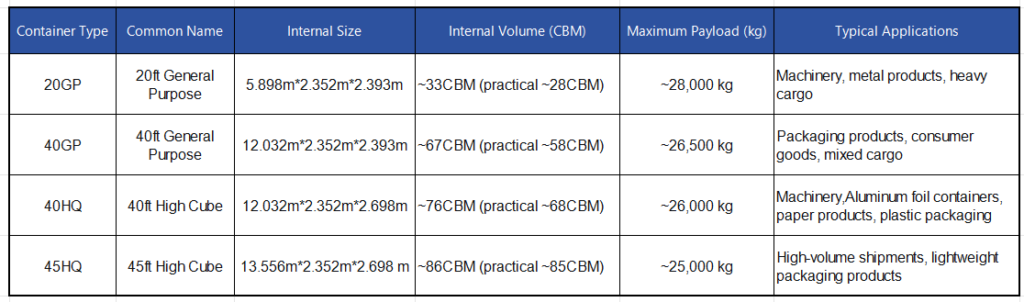
Below is a comparison of the four most frequently used containers in export logistics. Note that internal dimensions vary slightly between shipping lines and container manufacturers, but the numbers below are reliable industry averages.
20GP Container (20ft General Purpose)
The 20GP is for heavy, dense cargo. Its internal volume is about 33 CBM, but its payload capacity (around 28 metric tons) is actually higher than larger containers because the container itself weighs less.
Common uses in our export experience:
Machinery and equipment parts
Metal products (e.g., aluminum coils, steel pipes)
Bulk raw materials
Key insight: For heavy products, the 20GP’s weight limit is often the bottleneck. You might only use 15–20 CBM of space before reaching 28 tons. Always calculate both volume and weight.
40GP Container (40ft General Purpose)
The 40GP doubles the length of a 20GP, offering roughly 67 CBM of internal volume. However, its payload is slightly lower because the container is heavier. This is the go-to choice for medium-density products like packaged foods, household goods, and cartons of packaging materials.
When to choose a 40GP:
Your product isn’t extremely heavy (e.g., ≤ 25 tons per container)
You need more linear space for longer cartons
You want a balance between volume and weight capacity
40HQ Container (40ft High Cube)
The 40HQ is identical to the 40GP in length and width, but its interior height is about 30 cm (12 inches) taller. That extra height increases theoretical volume to ~76 CBM, but in practical loading, most exporters plan for 68–70 CBM after accounting for pallets, loading gaps, and carton stacking limits.
Why we often recommend 40HQ for packaging products:
Aluminum foil containers (stacked in cartons) benefit from the extra vertical space
Paper products and plastic packaging are lightweight but bulky—height matters
Palletized cargo: Standard pallets are about 1.44m tall; stacking two pallets high often requires a high cube
From what we’ve seen in actual container loading for packaging buyers, the 40HQ is the most popular choice because it offers the best compromise between volume, availability, and cost per CBM.
45HQ Container (45ft High Cube)
The 45HQ is the longest standard container available in most trade lanes. It provides ~85 CBM of practical loading volume—about 25% more than a 40HQ. However, not all ports or trucking companies handle 45-foot containers, and they are slightly more expensive to move inland.
Ideal for:
Very lightweight, high-volume products (e.g., foam packaging, empty plastic bottles)
Shipments where you need to maximize cubic meters rather than weight
Importers consolidating multiple orders into one container
Caveat: Always check with your freight forwarder whether your origin port and destination offer 45HQ availability. Some routes only support up to 40HQ.
How to Calculate Container Loading Capacity
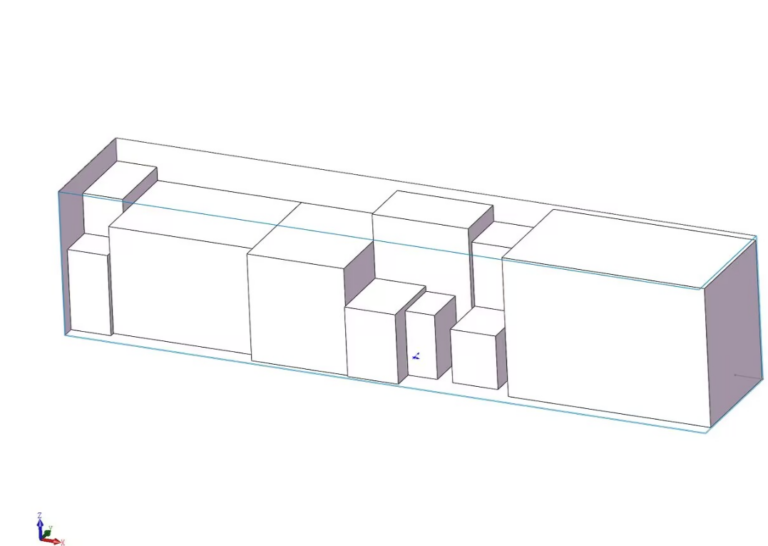
The basic formula is simple:
Container Loading Quantity (cartons) = Container Practical Volume (CBM) ÷ Carton Volume (CBM)
But real-world loading is never perfect. Let’s walk through a practical example.
Example: Aluminum Foil Container Shipment
Suppose you’re importing cartons of aluminum foil containers (e.g., full size pan, round pans). Each carton has the dimensions:
Length: 50 cm (0.5 m)
Width: 40 cm (0.4 m)
Height: 35 cm (0.35 m)
Step 1: Calculate carton volume in CBM
0.5 × 0.4 × 0.35 = 0.07 CBM per carton
Step 2: Choose container type — Let’s use a 40HQ. Theoretical volume is ~76 CBM, but practical usable volume after accounting for pallets, wall gaps, and stacking inefficiencies is closer to 68 CBM (about 90% efficiency).
Step 3: Divide container volume by carton volume
68 ÷ 0.07 = 971 cartons
Step 4: Apply a real-world adjustment
Few shipments achieve 100% space utilization. Depending on pallet dimensions, carton stacking patterns, and how tightly the loader packs, actual efficiency ranges from 85% to 95%. For this example, at 90% efficiency:
971 × 0.90 = 874 cartons (more realistic)
If you use a 20GP container (practical volume ~30 CBM after loading gaps):
30 ÷ 0.07 = 428 cartons × 0.90 ≈ 385 cartons
Why the difference matters: A 40HQ holds about 2.2 times more cartons than a 20GP, but the freight cost is only 1.5–1.8x higher. That’s why FCL shipments in larger containers often reduce your per-unit shipping cost significantly.
Pro tip: Always ask your supplier for a “container loading plan” or “pallet layout diagram” before production. Many experienced exporters can tell you exactly how many cartons fit based on their actual loading history with similar carton sizes.
Container Loading Requirements and Inspection Tips
Once the goods are loaded, many importers simply trust that everything went smoothly. From what we’ve seen in disputes and insurance claims, that trust can backfire. Here are two simple but powerful inspection steps.
Ask Suppliers for Container Loading Photos
Request a set of photos showing:
Empty container (with container number visible)
Loading in progress (shows stacking method and pallet condition)
Completed load (door open, showing filled space)
Door closed with seal (seal number clearly readable)
These photos help you verify cargo quantity, check for damage, and reduce disputes. If a supplier hesitates to provide loading photos, consider it a red flag.
Verify the Container Seal Number
Every container is sealed with a unique, tamper-evident seal after loading. The seal number appears on the Bill of Lading (B/L). When your container arrives, verify that the seal on the container matches the B/L exactly. Any mismatch could indicate tampering, theft, or an accidental container swap.
Why this matters: We’ve seen cases where a buyer received the wrong container because the seal number didn’t match. Without a photo record, proving fault is nearly impossible
FCL vs LCL Shipping
Which option is right for you? Let’s compare.
FCL (Full Container Load)
You book an entire container, even if you don’t fill it completely (though that’s inefficient).
Advantages:
Lower cost per CBM for shipments
Lower risk of cargo damage (your goods aren’t handled repeatedly)
Faster port handling and customs clearance
You control the loading process
Disadvantages:
Higher upfront cost for smaller orders
You pay for unused space
LCL (Less than Container Load)
Your goods share a container with other shippers’ cargo. The freight forwarder consolidates multiple LCL shipments into one FCL.
Advantages:
Lower initial investment (pay only for the volume you use)
Good for small shipments (e.g., 3–12 CBM)
No need to manage a full container
Disadvantages:
Higher freight cost per CBM (typically 30–50% more than FCL)
Additional handling at origin and destination (more damage risk)
Slower transit due to consolidation/deconsolidation
Your goods may be stacked under heavier cargo
A real-world comparison: For a 10 CBM shipment of aluminum foil containers, LCL might cost $400–$600. A 20GP FCL might cost $1,200–$1,800. If you need only 10 CBM, LCL seems cheaper. But if you can increase your order to fill a 20GP (e.g., 25–30 CBM), your per-CBM cost drops by 50% or more.
Why We Recommend Full Container Shipments
From what we’ve seen across hundreds of export projects—especially for packaging products and machinery—FCL shipments almost always provide better value once your order volume exceeds 15–18 CBM. Here’s why:
Lower transportation cost per unit – The fixed cost of a container is spread over more products.
Better cargo protection – Your goods are loaded once, sealed, and opened only at destination.
Faster customs handling – Full containers move through ports more quickly than LCL consolidations.
Easier shipment management – One container, one Bill of Lading, one delivery appointment.
For regular importers of aluminum foil containers, plastic packaging, paper products, or industrial machinery, we strongly recommend planning your purchase quantities around full container loads. Even if you don’t fill a 40HQ completely, a 20GP or 40GP FCL will usually beat LCL rates per CBM.
Conclusion
Understanding container loading capacity isn’t just logistics trivia—it’s a practical skill that directly affects your bottom line. Before you arrange your next shipment, take time to evaluate:
Which container type (20GP, 40GP, 40HQ, or 45HQ) best matches your product’s volume and weight?
How many cartons can realistically fit after accounting for pallets and loading gaps?
Is your order large enough to justify FCL, or does LCL make more sense for now?
Always request loading photos and verify the container seal number before the container leaves the factory. These small steps prevent costly disputes and give you peace of mind.
Efficient shipping reduces logistics costs and improves overall profitability. If you’re building a complete manufacturing business, our The Complete Guide to Starting an Aluminum Foil Container Manufacturing Business covers logistics planning alongside production, equipment, and factory setup.
FAQ
1. How many CBM fit in a 20GP container?
Theoretical volume is ~33 CBM, but practical usable volume after loading gaps and pallets is typically 28–30 CBM.
2. What is the difference between 40GP and 40HQ?
Both have the same length and width. The 40HQ is 30 cm (12 inches) taller, offering about 9–10 CBM of additional volume. Maximum payload is similar, but the 40HQ is better for lightweight, bulky cargo.
3. How much cargo can a 45HQ container hold?
A 45HQ container holds approximately 85–86 CBM of cargo, depending on loading efficiency. However, its payload is limited to about 25,000 kg, so weight may still be a constraint for dense products.
4. How do I calculate container loading quantity?
Use this formula: (Container practical volume in CBM) ÷ (Carton volume in CBM) × loading efficiency (typically 85–95%). Always test with actual pallet and carton dimensions.
5. Why should I request loading photos from suppliers?
Loading photos provide visual proof of cargo quantity, packaging condition, and loading method. They are invaluable for resolving disputes about short shipments or damage.
6. What is a container seal number?
A unique alphanumeric code on the tamper-evident seal attached to a loaded container. The seal number appears on the Bill of Lading and must match the physical seal at destination to verify cargo integrity.
7. What is the difference between FCL and LCL shipping?
FCL means you rent the entire container. LCL means you share container space with other shippers. FCL is cheaper per CBM for larger shipments; LCL works for smaller volumes but has higher handling costs and damage risk.
8. Which shipping method is better for packaging products?
For packaging products like aluminum foil containers, paper cups, or plastic lids, FCL is almost always better once your order exceeds 15–18 CBM. The lower per-unit cost and reduced damage risk outweigh the higher upfront payment.