
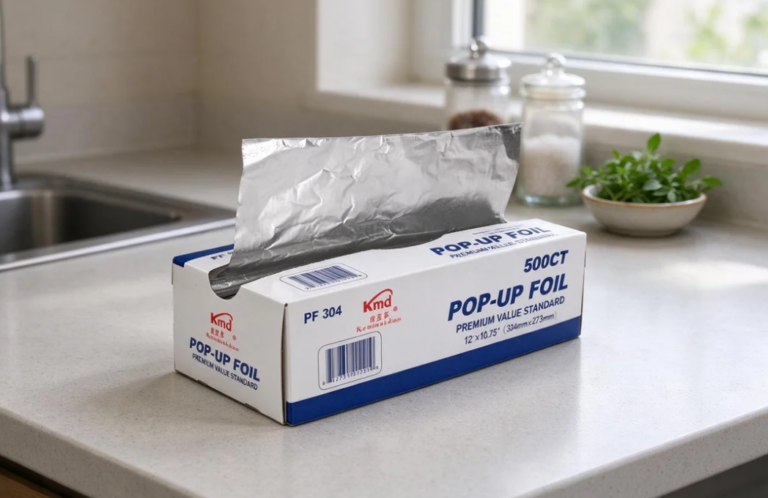
Interfolded Aluminum foil sheets are widely used in food-service, household, catering, takeaway, and packaging applications where pre-cut and folded foil sheets offer a convenient alternative to conventional foil rolls. Unlike standard aluminum foil rolls, pop up foil sheets are supplied in individual pieces and can be folded, stacked, dispensed, printed, or embossed according to the intended application.
For buyers, the product specification is about more than simply choosing a sheet size. Length, width, folding type, foil thickness, surface pattern, printing, and machine compatibility can all affect production efficiency and the final product.
Among these specifications, sheet length and folding type are particularly important because they are closely related to production equipment. A company that plans to manufacture several different sheet sizes should consider its target market before investing in an interleaving sheet production machine.
This guide explains the common specifications of aluminum foil interleaving sheets and the key points buyers should consider when selecting a suitable configuration.
Interfolded Aluminum Foil Sheet Market Overview
The market for pre-cut aluminum foil sheets is closely connected with the food-service and packaging industries. Compared with foil rolls, pre-cut sheets provide a ready-to-use format that can be convenient in restaurants, catering operations, commercial kitchens, takeaway businesses, and household applications.
The demand for aluminum foil sheets can vary considerably from one market to another. Some buyers focus on standardized dimensions for high-volume production, while others require customized sizes for specific packaging formats.
Several factors are influencing product specifications:
- Convenience in food preparation and packaging
- Demand for individually dispensed sheets
- Standardized packaging formats
- Retail and food-service requirements
- Customized sizes for specific applications
- Brand printing and product differentiation
For manufacturers and distributors, this means there is not necessarily one universal size that fits every market. A specification that is common in one region or application may not be suitable for another.
For this reason, buyers should identify their target customers and expected product dimensions before deciding on production equipment.
Common Lengths of Aluminum Foil Interleaving Sheets
Sheet length is one of the most important specifications when producing aluminum foil sheets.
The appropriate length depends on the folding method, application, packaging format, and machine configuration. Some dimensions are frequently encountered in the market, while customized lengths can also be produced when the equipment supports them.
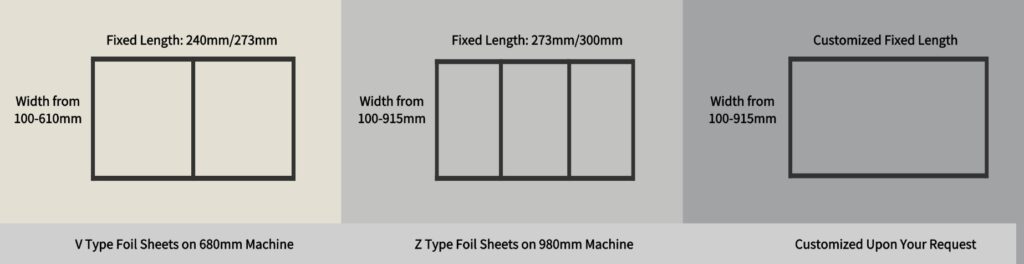
Two commonly discussed configurations are V-fold and Z-fold aluminum foil sheets.
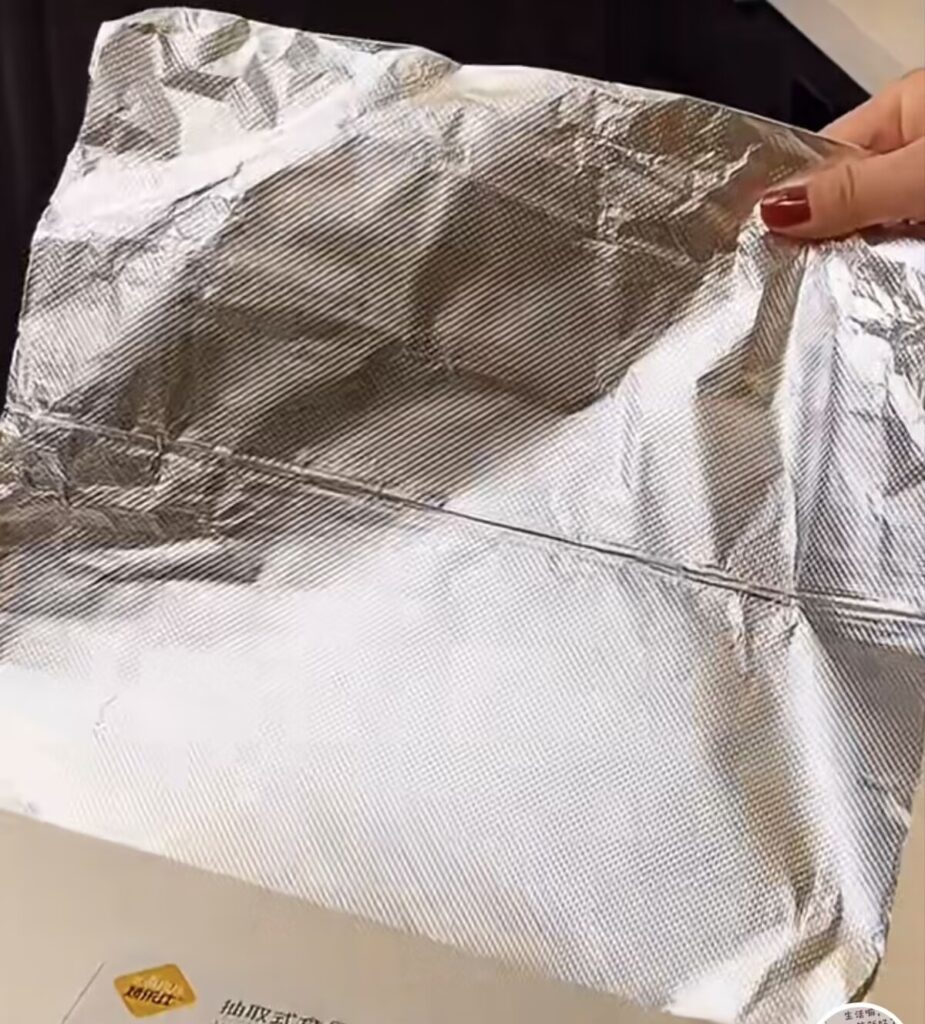
V-Fold: 240 mm and 273 mm
V-fold, also called one-fold in some production environments, is a relatively simple folding configuration.
Common lengths include:
- 240 mm
- 273 mm
These dimensions can be found in applications where a compact folded sheet is required. The actual specification, however, depends on the target market and the design of the finished product.
For manufacturers, the important point is not simply whether 240 mm or 273 mm is a common size. The more important question is whether the selected size matches the requirements of the customers and the production equipment.
Z-Fold: 273 mm and 300 m
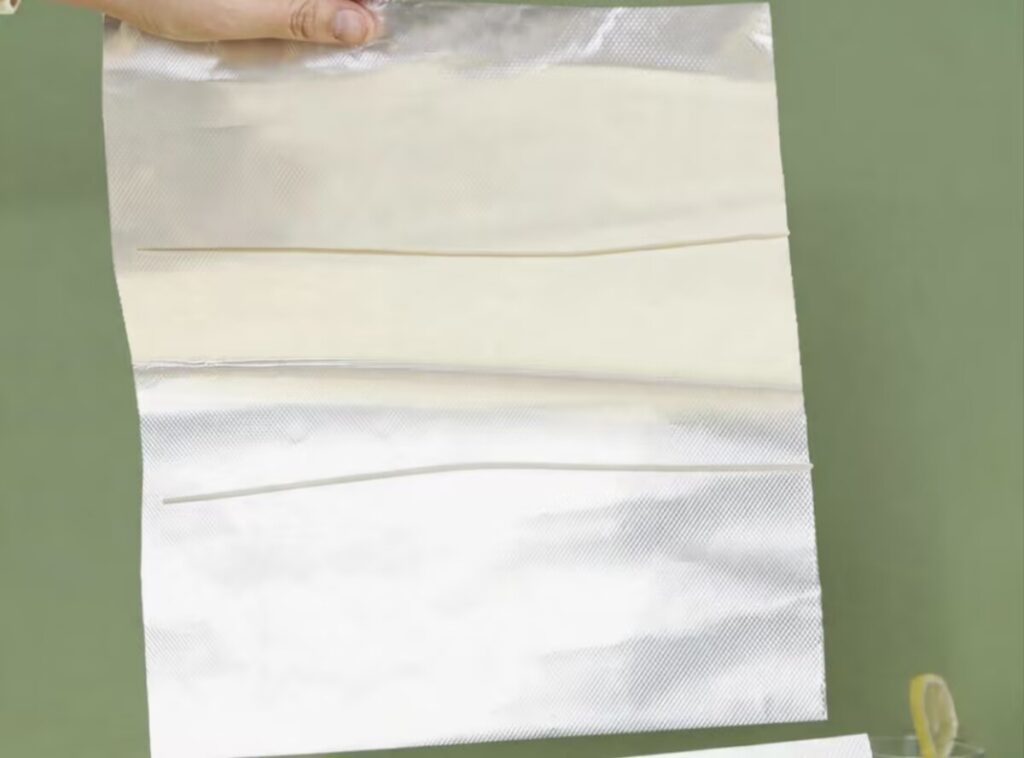
Z-fold aluminum foil sheets use a two-fold structure and are another common configuration.
Typical lengths include:
- 273 mm
- 300 mm
The Z-fold format allows individual sheets to be stacked and dispensed in a different way from V-fold sheets.
The choice between 273 mm and 300 mm should be based on factors such as the customer’s packaging requirements, the dimensions of the food container or application, and the available production equipment.
How Sheet Length Affects Machine Selection
For manufacturers, sheet length is more than a product specification. It can also be an equipment-selection issue.
Many aluminum foil sheet making machines are configured based on a specific sheet length. Machine capability varies by model, so buyers should confirm the available length and width range with the equipment supplier before purchasing.
For example, a manufacturer may initially plan to produce 273 mm sheets but later discover that customers also require 240 mm and 300 mm products. Depending on the machine design, producing several lengths may require additional equipment.
This is why the target sheet length should ideally be determined before purchasing the production machine.
The decision can influence:
- Machine configuration
- Production planning
- Tooling
- Production efficiency
- Product changeover
- Future expansion
A company planning to serve several different markets should therefore evaluate its expected product portfolio rather than selecting a machine based on only one current order.
Common Widths of Pre-cut Aluminum Foil Sheets
Compared with sheet length, width can vary more significantly between applications and markets.
There is no single global width that applies to all aluminum foil sheets. Width is normally determined by the intended application, packaging dimensions, folding configuration, aluminum foil roll width, and production equipment.
When selecting a width, buyers should consider:
- The size of the food container or package
- Required foil coverage
- Folding dimensions
- Available raw material width
- Material utilization
- Machine configuration
- Customer requirements
For manufacturers, the relationship between raw foil width and finished sheet width is particularly important. An inefficient width configuration can increase material waste, while a well-planned specification can improve material utilization.
Customized widths can therefore be valuable for customers with specific packaging requirements. However, customized production should be evaluated together with order volume and equipment capability.
Common Aluminum Foil Sheet Patterns
Aluminum foil interleaving sheets can be supplied with different surface finishes and patterns.
The most common options may include:
Plain or Smooth Surface
Plain aluminum foil has a relatively simple surface without a decorative embossing pattern.
It is often selected when the main priority is a straightforward appearance or when printing is more important than surface texture.
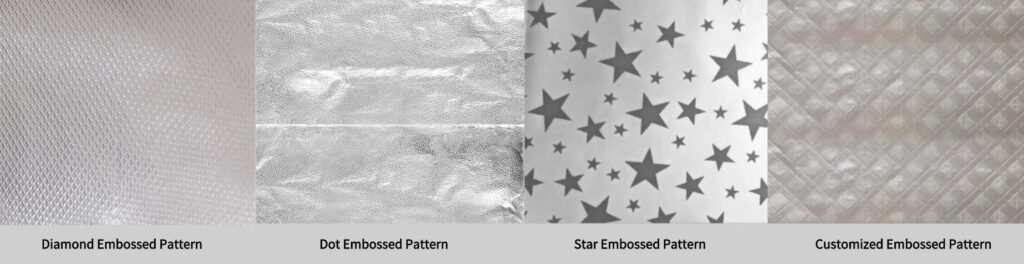
Embossed Patterns
Embossing creates a three-dimensional texture on the foil surface.
Common decorative patterns may include:
- Diamond patterns
- Textured patterns
- Repeating geometric patterns
- Customized decorative designs
Embossing can make the product visually different from plain foil and can also provide a more textured surface.
However, embossing should not automatically be described as improving performance. Its actual effect depends on the foil thickness, embossing depth, pattern design, and manufacturing process.
Branded or Customized Patterns
For companies selling branded food-service products, a customized surface pattern can be combined with printed graphics to create a distinctive appearance.
Pattern selection should take into account:
- Foil thickness
- Embossing process
- Printing requirements
- Product appearance
- Machine capability
- Customer expectations
Aluminum Foil Printing Colors and Design Options
Printing is increasingly relevant for companies that want aluminum foil sheets to function as part of their product branding.
Depending on the printing process and equipment, manufacturers may print elements such as:
- Brand logos
- Food-related graphics
- Decorative patterns
- Repeating brand elements
- Product identification information
For food-service products, printing can help distinguish one supplier’s products from generic aluminum foil sheets.
Instead of using only plain foil, businesses can incorporate their brand identity directly into the sheet.
The available printing colors depend on the printing process, ink system, foil surface, and equipment configuration.
Common colors include:
- Black
- Red
- Blue
- Green
- White
- Gold
- Silver
- Multi-color designs
Single-color printing is relatively straightforward and can be suitable for simple logos, text, or repeating brand information.
Two-color and multi-color printing provide more design flexibility and can be used for more detailed graphics.
However, buyers should not assume that every supplier can provide the same printing capability. Before confirming an order, it is useful to discuss:
- Number of colors
- Print coverage
- Artwork dimensions
- Repeat length
- Printing method
- Ink requirements
- Surface treatment
- Minimum order quantity
- Printing plate or cylinder requirements
- Artwork approval process
A good artwork design should also consider the folded structure. A logo or graphic that looks correct on the flat sheet may appear differently after folding.
Printing is increasingly relevant for companies that want aluminum foil sheets to function as part of their product branding.
Depending on the printing process and equipment, manufacturers may print elements such as:
- Brand logos
- Food-related graphics
- Decorative patterns
- Repeating brand elements
- Product identification information
For food-service products, printing can help distinguish one supplier’s products from generic aluminum foil sheets.
Instead of using only plain foil, businesses can incorporate their brand identity directly into the sheet.
How to Choose the Right Aluminum Foil Sheet Specification
A practical specification checklist can help prevent problems later in production.
Before placing an order, buyers should confirm:
- Target market
- End application
- Folding type
- Sheet length
- Sheet width
- Aluminum foil thickness
- Surface pattern
- Printing colors
- Artwork requirements
- Machine compatibility
- Dimensional tolerance
- Packaging requirements
- Expected production volume
- Food-contact compliance
- Customized specifications
For manufacturers purchasing production equipment, the sequence is particularly important.
The product specification should generally be determined first, followed by equipment selection.
In other words, it is better to ask:
What products do we need to manufacture?
before asking:
Which machine should we buy?
This approach can reduce the risk of purchasing equipment that does not match the company’s intended product range.
Conclusion
Aluminum foil sheets may look like a relatively simple packaging product, but their specifications involve several interconnected factors.
Length, width, folding type, foil thickness, surface pattern, printing, and machine compatibility should be considered as a complete product specification rather than as separate decisions.
For V-fold products, 240 mm and 273 mm are common length references, while 273 mm and 300 mm are common references for Z-fold products. However, these dimensions should not be treated as universal standards. Market requirements and equipment capabilities can vary.
For manufacturers planning to invest in production equipment, the most important step is to define the target product range before selecting the machine. If several lengths or folding configurations are required, the equipment’s flexibility should be evaluated at the beginning of the project.
Ultimately, the right aluminum foil sheet specification is the one that matches the application, target market, customer requirements, and production capabilities.
For suppliers and buyers alike, a clear specification at the beginning of the project can make production planning, equipment selection, printing, and quality control much easier.
FAQ Section
What are the common lengths of aluminum foil interleaving sheets?
Common configurations include 240 mm and 273 mm for V-fold sheets, while 273 mm and 300 mm are commonly used for Z-fold configurations. Customized lengths may also be available depending on the machine and supplier.
What is the difference between V-fold and Z-fold aluminum foil sheets?
V-fold sheets use a one-fold configuration, while Z-fold sheets use a two-fold configuration. The two designs have different stacking, dispensing, and production characteristics.
Can aluminum foil sheets be customized?
Yes. Depending on the production equipment, manufacturers may customize length, width, folding type, surface pattern, printing, and other specifications.
What widths are commonly available?
Width varies significantly according to the application and market. Rather than relying on one universal standard, buyers should select width according to the required packaging dimensions, folding configuration, raw material utilization, and machine capability.
Can aluminum foil interleaving sheets be printed?
Yes. Aluminum foil sheets can be printed with logos, text, graphics, brand information, and decorative elements, subject to the printing process and equipment.
How many colors can be printed on aluminum foil?
Single-color, two-color, and multi-color printing may be available. The actual number of colors depends on the printing machine, ink system, artwork, and supplier’s production capability.
Does sheet length affect machine selection?
Yes. Many machines are configured based on specific sheet lengths. Buyers should confirm machine capability before deciding on the final product length.
What specifications should I confirm before ordering?
At minimum, confirm the folding type, length, width, foil thickness, surface pattern, printing requirements, tolerance, packaging, application, production volume, and applicable compliance requirements.